

Gearbox Oil vs Grease: When Each Is Used
Choosing between gearbox oil and grease is a common question in industrial power transmission. While both lubricants reduce friction and protect internal components, they are not interchangeable and are used for very different gearbox designs and operating conditions.
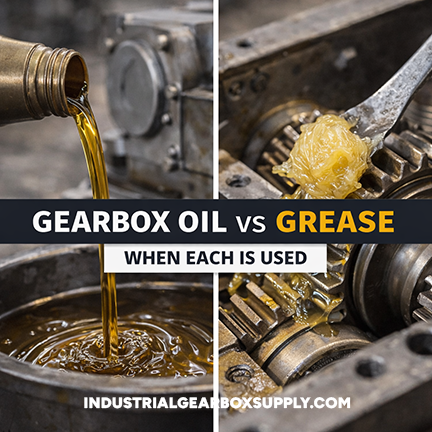
Using the wrong lubricant can lead to overheating, poor lubrication, accelerated wear, and premature failure. Understanding when gearbox oil is used versus when grease is appropriate helps ensure reliable operation and long service life.
This guide explains the differences between gearbox oil and grease and when each should be used.
Why Lubricant Type Matters in Gearboxes
Gearboxes rely on lubricant to form a protective film between gears, bearings, and shafts. That lubricant must be able to flow, cool, and protect under the specific operating conditions of the gearbox.
Oil and grease behave very differently under load, speed, and temperature. Selecting the correct type is critical to proper lubrication.
When Gearbox Oil Is Used
Gearbox oil is the most common lubricant used in industrial gearboxes.
Oil is used when gears and bearings require continuous lubrication, cooling, and contaminant removal. Oil circulates within the gearbox, forming a lubricating film on gear teeth and bearings while also carrying heat away from loaded components.
Gearbox oil is typically used in:
Helical gearboxes
Bevel gearboxes
Planetary gearboxes
High-speed gear reducers
Gearboxes operating under continuous duty
Oil-lubricated gearboxes are designed with sumps, splash lubrication, or forced circulation systems to ensure consistent oil delivery.
Advantages of Gearbox Oil
Gearbox oil offers several advantages in industrial applications.
Oil provides excellent heat dissipation, which helps control operating temperature. It flows easily to lubricate all internal components, even at higher speeds. Oil also helps flush contaminants away from critical surfaces and supports oil analysis for condition monitoring.
For most industrial gearboxes, oil is the preferred and recommended lubricant.
When Grease Is Used in Gearboxes
Grease is used in specific gearbox designs where oil lubrication is not practical or necessary.
Grease is a semi-solid lubricant that stays in place and does not circulate like oil. It is typically used in low-speed, sealed, or intermittently operated gearboxes.
Grease-lubricated gearboxes are commonly found in:
Small or compact gear reducers
Worm gearboxes in low-speed applications
Enclosed or sealed gear units
Gearboxes mounted in difficult orientations
Applications where leakage must be minimized
Grease is also used in some gearboxes where relubrication intervals are long or access is limited.
Advantages of Grease Lubrication
Grease remains in place and resists leakage, making it useful in applications where oil containment is difficult.
Grease provides good protection in low-speed or shock-load applications and can offer corrosion protection in harsh environments.
Because grease does not circulate, it may reduce the need for frequent relubrication in some applications.
Limitations of Grease in Gearboxes
Grease has limitations that make it unsuitable for many industrial gearboxes.
Grease does not dissipate heat as effectively as oil. It does not flush contaminants away from contact surfaces and cannot be easily monitored through oil analysis.
In higher-speed applications, grease can cause excessive drag, increased temperature, and poor lubrication distribution.
Grease should never be used in a gearbox designed for oil lubrication unless explicitly approved by the manufacturer.
Oil vs Grease: Key Differences in Gearbox Applications
Oil flows and circulates, providing continuous lubrication and cooling. Grease stays in place and relies on mechanical movement to redistribute lubricant.
Oil is preferred for continuous-duty, higher-speed, and higher-load gearboxes. Grease is limited to low-speed, sealed, or compact designs where oil circulation is not required.
Oil supports condition monitoring and extended service life, while grease prioritizes simplicity and containment.
Manufacturer Recommendations Matter
Gearbox manufacturers design gearboxes around a specific lubrication method.
Using oil in a grease-designed gearbox can cause leakage and starvation. Using grease in an oil-designed gearbox can cause overheating and gear damage.
Always follow the gearbox manufacturer’s lubrication recommendations for type, viscosity, and service intervals.
Common Mistakes When Choosing Between Oil and Grease
One common mistake is assuming grease is better because it does not leak. In reality, grease-related overheating is a frequent cause of gearbox failure.
Another mistake is mixing grease and oil without confirming compatibility. Mixing lubricants can destroy additive performance and reduce protection.
Lubricant selection should always be based on gearbox design and operating conditions—not convenience.
Final Thoughts
Gearbox oil and grease serve different purposes in industrial gearboxes. Oil is the standard choice for most industrial gear reducers due to its superior cooling, lubrication, and monitoring capabilities. Grease is reserved for specific low-speed or sealed designs where oil is not practical.
Selecting the correct lubricant protects gears, bearings, and seals while maximizing performance and service life.
If you need help determining whether your gearbox should use oil or grease, or selecting the correct lubricant for your application, IndustrialGearboxSupply.com can help guide you toward the right solution.