

Gearbox Replacement: How to Choose the Right Replacement and Supplier
When an industrial gearbox fails, operations come to a halt. A sudden breakdown can lead to costly downtime, production delays, and even damage to connected systems. Whether your gearbox is worn beyond repair or you're proactively upgrading to a better model, knowing how to handle gearbox replacement quickly and correctly is essential.
This guide walks you through everything you need to know—from identifying the need to finding the right supplier.
Why Gearbox Replacement Matters
Gearboxes are critical components that convert torque and control speed in industrial machines. Over time, even the most durable gear reducers wear out due to friction, heat, overload, or contamination. When that happens, you’re left with two choices: repair or replace.
Replacement is the better choice when:
The cost of repair approaches the cost of a new unit.
Parts are obsolete or no longer available.
Downtime must be minimized with fast installation.
You need upgraded performance or energy efficiency.
Signs You Need a Gearbox Replacement
Before a catastrophic failure occurs, look for these red flags:
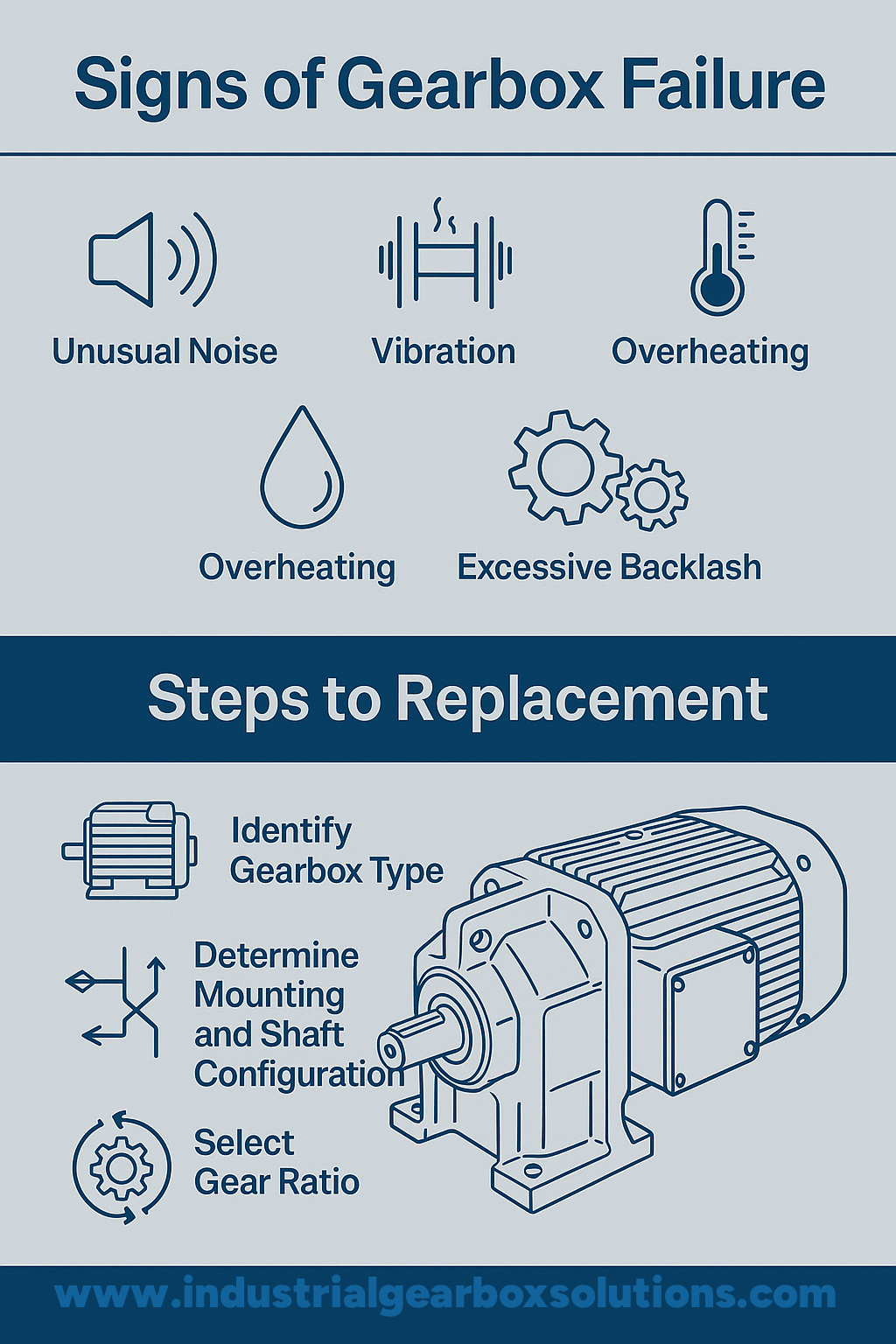
Unusual Noise: Grinding, clunking, or whining sounds often point to internal gear wear or misalignment.
Vibration: Excess vibration may indicate imbalance, bearing failure, or gear tooth damage.
Leaking Oil: Failed seals, gaskets, or housing cracks lead to lubrication loss and increased friction.
Overheating: Gearboxes that run too hot are at risk of seizing or premature failure.
Declining Output: Reduced torque or inconsistent motion can signal worn or damaged internal components.
Excessive Backlash: If you notice increased gear play, your gearbox may no longer meet performance specs.
How to Identify the Right Replacement Gearbox
When replacing an industrial gearbox, a direct one-to-one match isn’t always possible. Older models may be discontinued, and upgrades often provide better performance. Here’s what to consider:
1. Gearbox Type
Determine the type of gearbox you’re replacing:
Helical
Bevel
Worm
Planetary
Inline
Right angle
2. Mounting and Shaft Configuration
Check:
Foot-mounted vs. flange-mounted
Shaft orientation (vertical/horizontal)
Hollow or solid shaft
Input/output shaft dimensions
3. Gear Ratio
Match or calculate the required gear reduction ratio to maintain the same output speed and torque.
4. Torque and Horsepower Ratings
Ensure the replacement gearbox can handle your application’s torque and HP requirements—preferably with a safety factor.
5. Frame Size and Dimensions
Measure the original gearbox and compare dimensions to ensure compatibility with your existing setup.
Choosing the Right Gearbox Supplier
Selecting a supplier is just as important as the gearbox itself. Here’s what to look for:
Expert Interchange Support: Can they cross-reference obsolete models?
Fast Lead Times: Do they stock or build gearboxes in-house to reduce delays?
Engineering Support: Can they help you size or select the correct model?
Customization Options: OEM labeling, paint, gear ratio modifications?
Warranty and Support: Are you covered if issues arise after installation?
Why Choose Industrial Gearbox Supply for Replacement Gearboxes?
At Industrial Gearbox Supply, we specialize in fast, reliable gearbox replacements for all major brands and industrial applications. Here’s what sets us apart:
Wide Inventory: From Cone Drive to Radicon and Nord, we supply both new and replacement gearboxes across the most in-demand models.
Expert Matching: Our team helps you identify the exact match—or the best alternative—for legacy or discontinued units.
Fast Turnaround: We offer ready-to-ship options and build-to-order gearboxes with minimal lead time.
Customization: Laser-engraved labels, washdown duty units, and special paint finishes are available.
Support: Over 100 years of combined experience in gearbox repair, rebuilding, and supply.
Rebuilding vs. Replacing: What’s Right for You?
| Criteria | Rebuild | Replace |
|---|---|---|
| Cost | Lower upfront cost | Higher, but predictable long-term |
| Time | Depends on parts availability | Faster with in-stock units |
| Upgrades | Limited | Modern materials and energy efficiency |
| Warranty | Limited or none | Full manufacturer or distributor warranty |
| Obsolete Units | Harder to find parts | Often requires upgrade |
If your current unit is heavily damaged or obsolete, replacement is often the faster and more cost-effective choice.
Common Replacement Gearbox Brands We Carry
ABB / Baldor
Cone Drive
Radicon
Nord Drivesystems
SEW-Eurodrive
Dodge / Reliance
Boston Gear
Sumitomo
Industries We Serve
Food & Beverage
Mining & Aggregates
Agriculture
Pulp & Paper
Water & Wastewater
Manufacturing
Packaging
Chemical Processing
Order Your Gearbox Replacement Today
Time is money. If you’re facing a gearbox failure, don’t wait. Let Industrial Gearbox Supply help you replace your unit with the right gearbox—fast.
📞 Call us at 1-877-465-9108
🌐 Visit: https://industrialgearboxsupply.com
📧 Email: support@industrialgearboxsupply.com
Let’s get your operation back up and running.