

How to Read a Gearbox Nameplate
A gearbox nameplate contains critical information needed for proper operation, maintenance, replacement, and troubleshooting. Understanding how to read a gearbox nameplate helps ensure you select the correct replacement unit, use the proper lubricant, and avoid operating conditions that can cause premature failure.
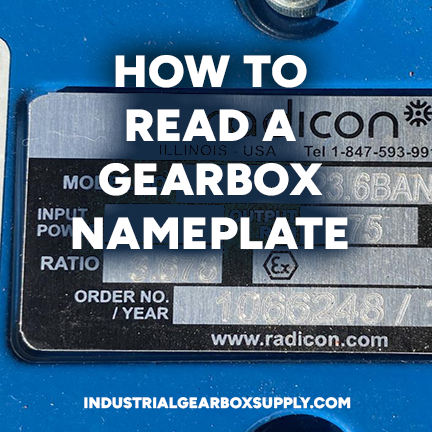
Many gearbox issues arise simply because nameplate information is misunderstood or ignored. This guide explains how to read a gearbox nameplate and what each common field means.
What Is a Gearbox Nameplate?
A gearbox nameplate is a metal or engraved plate attached to the gearbox housing. It lists key specifications defined by the manufacturer.
Nameplate data identifies how the gearbox was designed to operate. This information should always be referenced before installation, lubrication, or replacement.
Common Information Found on a Gearbox Nameplate
While nameplates vary by manufacturer, most industrial gearboxes include the same core data points.
Manufacturer and Model Number
The manufacturer name identifies who built the gearbox. The model number defines the gearbox series, size, and configuration.
Model numbers often encode:
Gearbox type (helical, bevel, worm, planetary)
Frame size
Mounting style
Shaft configuration
Ratio range
Accurate model identification is essential when sourcing replacement parts or interchange gearboxes.
Serial Number
The serial number uniquely identifies the gearbox.
It is used to:
Track manufacturing details
Verify original specifications
Confirm build options
Support warranty claims
Always record the serial number before the nameplate becomes worn or unreadable.
Gear Ratio
The gear ratio shows the relationship between input speed and output speed.
It may be displayed as:
A ratio (e.g., 25:1)
Input RPM and output RPM values
The ratio determines output speed and torque and must match application requirements.
Input Speed (RPM)
The input speed indicates the maximum allowable rotational speed at the gearbox input shaft.
This value is typically matched to the driving motor speed. Exceeding the rated input speed can cause overheating, bearing damage, and gear failure.
Output Speed (RPM)
The output speed is the resulting shaft speed after speed reduction.
This value is derived from the input speed and ratio and is critical for matching driven equipment requirements.
Rated Torque
Rated torque specifies the maximum continuous torque the gearbox is designed to handle at the output shaft.
This value is often shown in:
lb-ft
lb-in
Nm
Operating beyond rated torque significantly shortens gearbox life.
Service Factor
Service factor indicates how much overload the gearbox can tolerate under specific conditions.
A service factor greater than 1.0 means the gearbox can handle additional load for certain applications. Service factor must be considered when evaluating real-world duty cycles.
Power Rating (HP or kW)
Some nameplates list power rating instead of torque.
Power rating is based on:
Input speed
Ratio
Service factor
Gearbox design
Torque is generally the more critical value, but power rating can be useful for quick checks.
Mounting Position
Many gearboxes specify the approved mounting position on the nameplate.
Mounting position affects lubrication distribution, breather function, and oil level. Installing a gearbox in an unapproved orientation can lead to lubrication starvation or leakage.
Lubricant Type and Viscosity
Some nameplates include lubricant recommendations.
This may specify:
Oil type (mineral, synthetic, food grade)
ISO viscosity grade (e.g., ISO VG 220)
Grease type (if applicable)
Always follow manufacturer lubricant recommendations to avoid efficiency loss or damage.
Thermal Rating or Duty Cycle
Some industrial gearboxes include thermal or duty ratings.
These indicate how much heat the gearbox can dissipate under continuous operation. Exceeding thermal limits leads to overheating and lubricant breakdown.
Certifications and Compliance Marks
Nameplates may include compliance information such as:
CE marking
ATEX rating
IP rating (indicating environmental sealing)
These markings help determine suitability for hazardous or washdown environments.
Why Nameplate Information Matters
Ignoring nameplate data leads to common problems such as:
Overspeeding
Overloading
Incorrect lubrication
Improper mounting
Premature failure
Nameplate information ensures that the gearbox is used within its design limits.
Using the Nameplate for Replacement and Interchange
When replacing a gearbox, nameplate data provides the foundation for selecting an equivalent or interchangeable unit.
Key values to match include:
Gear ratio
Rated torque
Input and output speed
Mounting configuration
Shaft dimensions
Accurate nameplate interpretation prevents costly sizing errors.
When Nameplates Are Missing or Unreadable
If the nameplate is damaged or missing, gearbox identification becomes more challenging.
In these cases, information can often be determined by:
Measuring shaft dimensions
Counting gear teeth (if accessible)
Reviewing installation drawings
Consulting original equipment documentation
Working with a gearbox specialist helps avoid incorrect assumptions.
Final Thoughts
A gearbox nameplate is more than a label—it is the gearbox’s operating blueprint.
Understanding how to read a gearbox nameplate helps prevent misuse, ensures correct replacement, and supports long-term reliability.
If you need help interpreting a gearbox nameplate or finding a compatible replacement, IndustrialGearboxSupply.com can help guide you toward the right solution.