

Slewing Bearings: What They Are, Types, and Where They’re Used
Define slewing bearings (also known as slew bearings). Then, categorize slewing bearing types and identify common industrial applications.
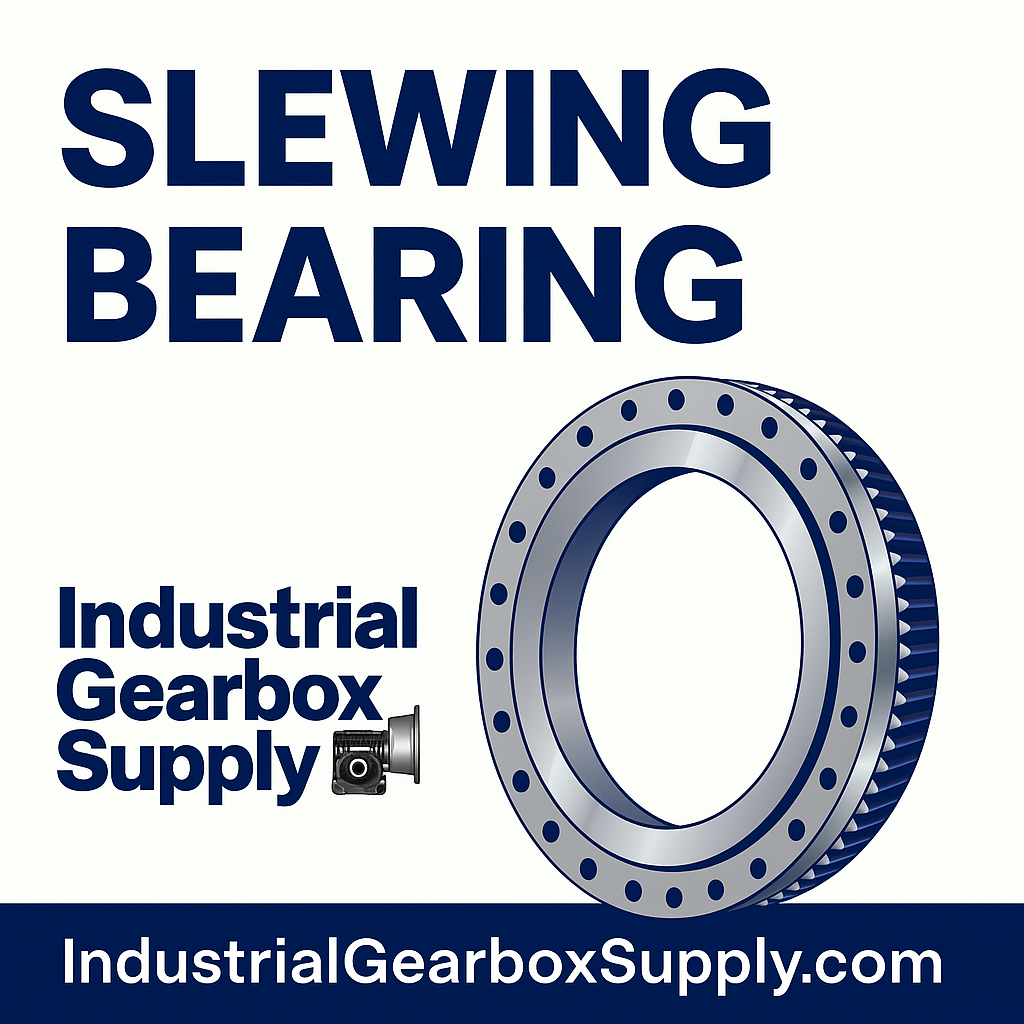
🔄 What Is a Slewing Bearing?
A slewing bearing (also known as a slew bearing) is a large rotational rolling-element bearing designed to support axial, radial, and moment loads simultaneously. These bearings enable smooth rotational movement in heavy-duty machinery and are typically found in:
Cranes
Excavators
Wind turbines
Industrial robots
Automated assembly systems
Unlike standard bearings, slewing bearings often operate under extreme stress and support both oscillating and continuous rotation.
🧱 Key Functions of Slewing Bearings
Rotation Support: Enable horizontal or vertical movement of massive structures
Load Management: Handle radial, axial, and tilting moment loads
Space Efficiency: Replace multiple components with a single integrated bearing
Durability: Designed for longevity under harsh industrial conditions
🔧 Types of Slewing Bearings
| Type | Description & Application |
|---|---|
| Single-Row Ball | Simple design for light to medium loads (e.g., packaging machines) |
| Double-Row Ball | Higher axial load capacity, used in mobile cranes |
| Cross Roller Bearing | Offers high precision and rigidity, common in robotics |
| Three-Row Roller | Handles the heaviest loads in construction or mining |
| Slewing Drive Assemblies | Integrate worm gear or planetary drive for powered motion |
Each type of slew bearing is selected based on rotation speed, load type, and space constraints.
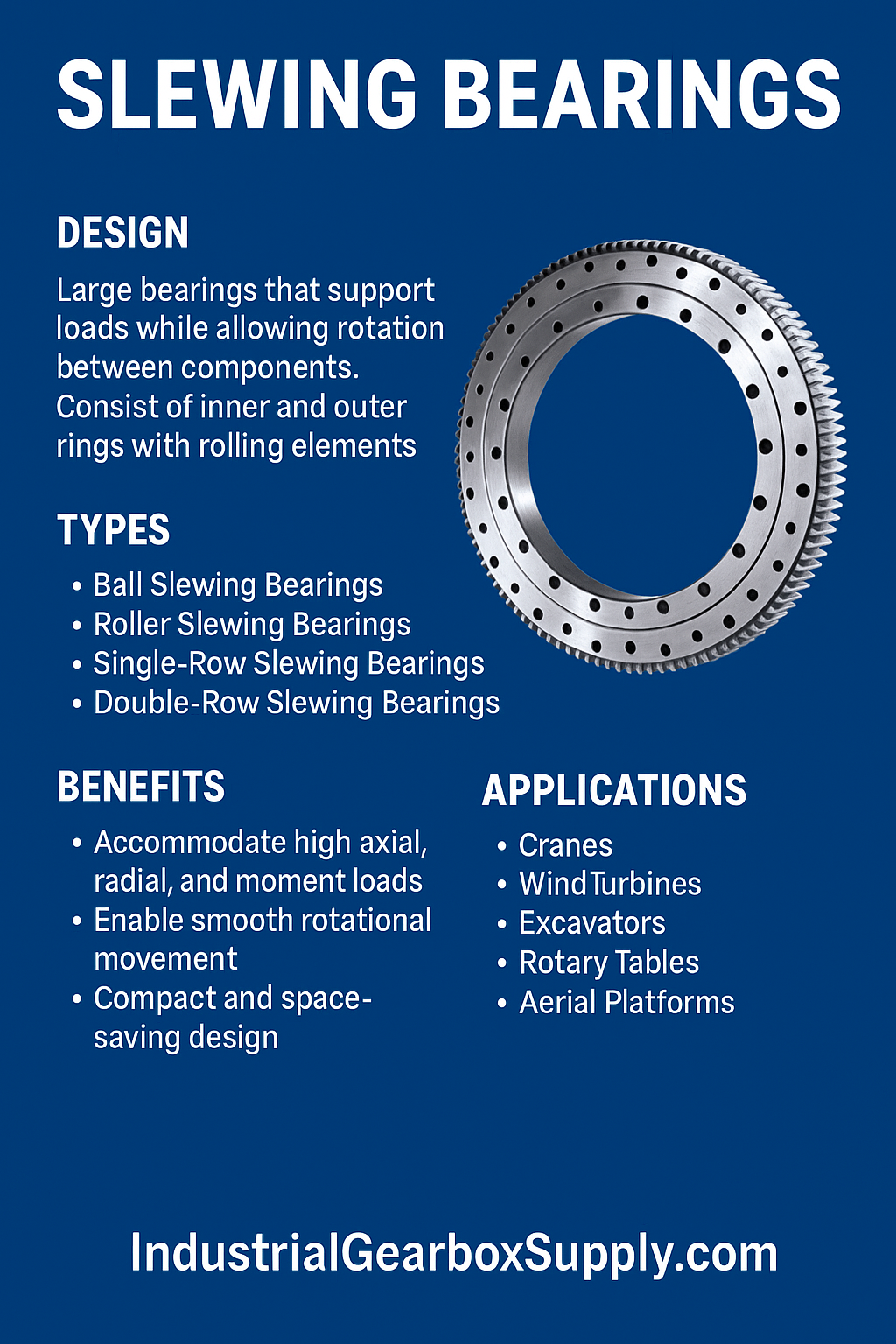
⚙️ Slewing Drive vs Slewing Bearing
A slewing drive is a complete system that includes a slewing bearing combined with a gearbox and sometimes a motor.
ComponentRoleSlewing BearingHandles the load and rotationSlewing DriveAdds motion via gear/power input (e.g., worm drive)
🏭 Where Are Slewing Bearings Used?
Slewing bearings are essential in any application where large-scale rotation and high load-bearing capacity are required.
Common Industries & Applications:
🏗 Construction Equipment: Tower cranes, mobile cranes, concrete pumps
⚙ Automation & Robotics: Articulated robots, pick-and-place arms
🌬 Wind Energy: Blade pitch and yaw systems
🚛 Transport Vehicles: Rotating platforms and trailers
🧪 Medical Devices: CT and MRI scanning tables
📦 Packaging Lines: High-speed rotary machines
✅ Benefits of Slewing Bearings
Compact & Integrated: Combines bearing + gear + mounting in one
Reduced Maintenance: Greasable designs with long life cycles
Cost-Effective: Fewer components mean easier installation and servicing
High Load Handling: Withstands extreme forces and moment loads
Customizable: Available in varied sizes, materials, and sealing options
🔍 How to Choose the Right Slewing Bearing
When selecting a slew bearing, evaluate:
Load Type: Axial, radial, moment
Rotation Speed & Duty Cycle
Mounting Orientation
Space Limitations
Sealing & Lubrication Requirements
Environmental Factors: Dust, humidity, temperature
Industrial Gearbox Supply can help you choose the right slewing bearing or slewing drive system for your specific industrial setup.
📞 Need Help With Slewing Bearings?
Whether you're designing a new machine or replacing a worn-out bearing, we offer guidance, product sourcing, and custom solutions for slewing bearings.
Contact Industrial Gearbox Supply:
📍 3590 Scheele Dr, Jackson, MI 49202
📞 Call: (517) 858-2966
📧 Email: sales@industrialgearboxsupply.com
🌐 www.industrialgearboxsupply.com