

Gearbox Bearings: Types, Functions, and Failure Modes
Gearbox bearings are critical components that support shafts, maintain alignment, and allow smooth transmission of power. While gears often receive the most attention, bearing failure is one of the most common causes of gearbox breakdowns.
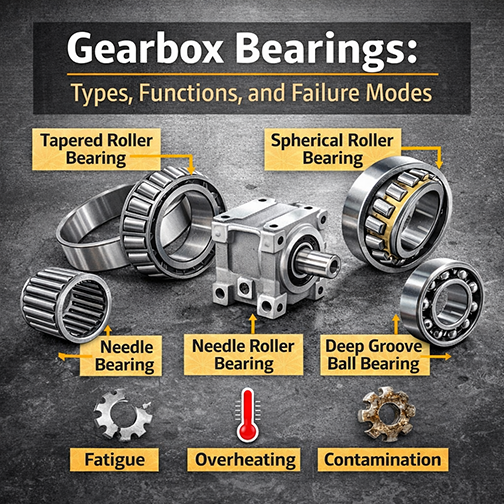
Understanding gearbox bearing types, their functions, and common failure modes helps prevent unexpected downtime and extends gearbox service life.
What Bearings Do Inside a Gearbox
Bearings support rotating shafts while minimizing friction and controlling movement. Inside a gearbox, bearings must handle combinations of radial loads, axial loads, and dynamic forces created by gear meshing.
Proper bearing performance ensures:
Accurate gear alignment
Smooth torque transmission
Low vibration and noise
Controlled shaft positioning
When bearings fail, secondary damage to gears, seals, and housings often follows.
Common Types of Gearbox Bearings
Industrial gearboxes use several bearing types depending on load, speed, and design requirements.
Ball Bearings
Ball bearings are commonly used in light to moderate load applications.
They are well suited for:
High-speed operation
Low to moderate radial and axial loads
Compact gearbox designs
Ball bearings offer low friction but have limited load-carrying capacity compared to roller bearings.
Cylindrical Roller Bearings
Cylindrical roller bearings handle higher radial loads than ball bearings.
They are commonly used in:
Helical gearboxes
High-torque applications
Gearboxes with heavy radial loading
These bearings allow high load capacity but typically require separate axial load control.
Tapered Roller Bearings
Tapered roller bearings are designed to handle combined radial and axial loads.
They are frequently used in:
Bevel gearboxes
Right-angle gearboxes
Applications requiring precise shaft positioning
Proper preload adjustment is critical for tapered roller bearings to avoid overheating or premature wear.
Spherical Roller Bearings
Spherical roller bearings accommodate misalignment and heavy loads.
They are often found in:
Large industrial gearboxes
Shock-load applications
Equipment subject to shaft deflection
Their self-aligning capability makes them suitable for demanding environments.
Thrust Bearings
Thrust bearings support axial loads only.
They are used when:
Significant axial forces are present
Gear geometry creates thrust loads
Shaft positioning must be controlled
Thrust bearings are often paired with other bearing types to handle combined loads.
How Bearings Affect Gearbox Performance
Bearing selection directly impacts gearbox efficiency, noise, and lifespan.
Incorrect bearing type or size can lead to:
Excessive friction
Increased heat generation
Shaft misalignment
Gear tooth damage
Bearings also influence lubrication flow and thermal behavior inside the gearbox.
Common Gearbox Bearing Failure Modes
Most gearbox bearing failures follow predictable patterns.
Lubrication Failure
Insufficient, incorrect, or contaminated lubrication is the leading cause of bearing failure.
Lubrication problems lead to:
Metal-to-metal contact
Excessive heat
Rapid surface wear
Incorrect oil viscosity or degraded lubricant accelerates bearing damage.
Contamination
Dirt, moisture, and debris entering the gearbox damage bearing surfaces.
Contamination causes:
Abrasive wear
Surface pitting
Accelerated fatigue
Even small particles can significantly reduce bearing life.
Overloading
Bearings designed for specific load ratings fail prematurely when overloaded.
Overloading may result from:
Incorrect gearbox sizing
Excessive torque
Shock loads
Improper service factor selection
Overloaded bearings often show spalling or cage damage.
Misalignment
Shaft misalignment places uneven loads on bearing elements.
Misalignment causes:
Edge loading
Increased vibration
Premature fatigue
Misalignment often originates from improper mounting or foundation issues.
Improper Installation
Incorrect installation practices frequently damage bearings before operation even begins.
Common installation errors include:
Hammering bearings onto shafts
Incorrect preload or clearance
Improper heating methods
Misaligned bearing seats
Installation damage often leads to early failure.
Fatigue and Wear
Even properly maintained bearings eventually fail due to fatigue.
Rolling contact fatigue appears as:
Surface spalling
Flaking
Pitting
Bearing life depends on load, speed, lubrication, and operating conditions.
Early Warning Signs of Bearing Failure
Bearing problems usually develop gradually.
Common warning signs include:
Increasing vibration
Unusual noise (whining or grinding)
Rising operating temperature
Metal particles in oil
Increased power consumption
Early detection allows corrective action before catastrophic failure.
How Bearing Failure Impacts the Entire Gearbox
Bearing failure rarely occurs in isolation.
Failed bearings often lead to:
Gear tooth misalignment
Seal damage and leakage
Housing wear
Secondary gear failure
Addressing bearing issues early prevents expensive cascading damage.
Preventing Gearbox Bearing Failure
Preventive measures include:
Correct bearing selection
Proper lubrication type and viscosity
Clean oil and contamination control
Accurate alignment and mounting
Routine vibration and oil analysis
Following manufacturer installation procedures
Preventive maintenance significantly extends bearing and gearbox life.
When Bearings Should Be Replaced
Bearings should be replaced when:
Vibration or noise trends worsen
Spalling or pitting is detected
Oil analysis indicates wear debris
Gearbox is disassembled for major service
Proactive bearing replacement is often more cost-effective than reactive repairs.
Final Thoughts
Gearbox bearings play a critical role in supporting loads, maintaining alignment, and ensuring smooth operation. Understanding bearing types, functions, and failure modes helps prevent unexpected breakdowns and extends gearbox life.
Most gearbox failures can be traced back to bearing issues caused by lubrication problems, contamination, misalignment, or overload.
If you need help diagnosing bearing-related gearbox issues or selecting the correct bearing solution, IndustrialGearboxSupply.com can help guide you toward the right answer.