

Gearbox Seals Explained: Types, Materials, and Wear Signs
Gearbox seals play a critical role in retaining lubricant and preventing contamination. While seals are relatively small components, seal failure is a leading cause of oil leaks, contamination, bearing damage, and premature gearbox failure.
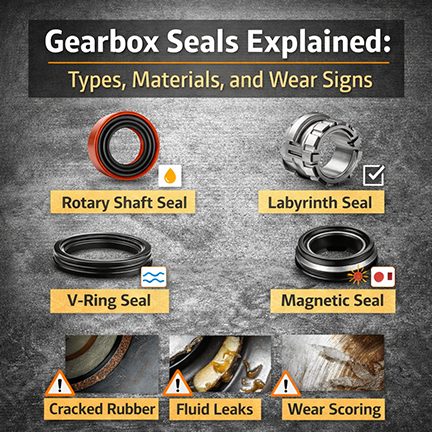
Understanding gearbox seal types, materials, and early wear signs helps prevent costly downtime and secondary damage.
What Gearbox Seals Do
Gearbox seals serve two primary functions:
They keep lubricant inside the gearbox and keep contaminants out.
By maintaining a sealed environment, gearbox seals protect gears, bearings, and internal components from dirt, moisture, and debris while ensuring proper lubrication.
When seals fail, lubricant loss and contamination quickly degrade gearbox performance.
Common Types of Gearbox Seals
Industrial gearboxes use several seal types depending on shaft speed, pressure, temperature, and environment.
Radial Lip Seals
Radial lip seals are the most common gearbox seal type.
They consist of a flexible sealing lip that contacts the rotating shaft, usually assisted by a garter spring to maintain pressure.
Radial lip seals are effective for:
Moderate shaft speeds
Oil retention
Standard industrial environments
They are widely used on both input and output shafts.
Mechanical Seals
Mechanical seals use two flat sealing faces—one rotating and one stationary—to create a tight seal.
They are used in more demanding applications where leakage must be minimized.
Mechanical seals are suitable for:
High shaft speeds
Higher pressures
Severe operating conditions
They are less common in standard gearboxes but may be used in specialized designs.
Labyrinth Seals
Labyrinth seals do not rely on direct contact with the shaft.
Instead, they use a series of grooves or passages that restrict contaminant entry while allowing minimal leakage.
Labyrinth seals are ideal for:
High-speed applications
Dusty environments
Situations where minimal friction is desired
They are often paired with other seal types for added protection.
V-Ring Seals
V-ring seals are elastomeric seals that rotate with the shaft and seal axially against a stationary surface.
They provide secondary sealing and are often used to protect primary seals from contamination.
V-rings are especially effective in dirty or wet environments.
Common Gearbox Seal Materials
Seal material selection depends on temperature, lubricant type, chemical exposure, and operating conditions.
Nitrile Rubber (NBR)
Nitrile rubber is the most common seal material.
It offers good resistance to:
Mineral oils
Moderate temperatures
General industrial conditions
NBR seals are cost-effective but have limited high-temperature capability.
Fluoroelastomer (FKM / Viton®)
FKM seals provide superior resistance to:
High temperatures
Synthetic oils
Chemical exposure
They are commonly used in high-temperature or continuous-duty applications.
Polyacrylate (ACM)
Polyacrylate seals are used where higher temperature resistance is needed than NBR but chemical exposure is moderate.
They are often found in automotive and light industrial applications.
Polytetrafluoroethylene (PTFE)
PTFE seals offer excellent chemical resistance and low friction.
They perform well in:
High-speed applications
Harsh chemical environments
Extreme temperatures
PTFE seals are more expensive and often require precise installation.
How Shaft Surface Finish Affects Seal Life
Seal performance depends heavily on shaft surface finish.
Rough, damaged, or improperly machined shafts accelerate seal wear and cause leaks.
Shafts should meet manufacturer-recommended surface finish and hardness specifications to ensure long seal life.
Common Wear Signs of Gearbox Seal Failure
Seal failure usually develops gradually.
Oil Leaks
Visible oil leakage around the shaft is the most obvious sign of seal failure.
Leaks may appear as:
Oil dripping
Oil misting
Grease buildup mixed with dirt
Even minor leaks should be addressed promptly.
Contamination Inside the Gearbox
Seal failure allows dirt, dust, and moisture to enter the gearbox.
Contamination leads to:
Abrasive wear
Bearing damage
Lubricant degradation
Water contamination is especially damaging and often results from failed seals.
Hardened or Cracked Seals
Heat and age cause elastomer seals to harden and crack.
Hardened seals lose flexibility and sealing pressure, leading to leakage.
Grooved or Worn Shafts
Seals running on damaged shafts wear rapidly.
Grooves, corrosion, or fretting on the shaft surface indicate prolonged seal issues.
Increased Temperature and Noise
Lubricant loss from leaking seals increases friction and heat.
Rising temperature and unusual noise often follow seal failure.
Common Causes of Gearbox Seal Failure
Several factors contribute to premature seal failure.
Improper installation is a major cause. Installing seals crooked, damaged, or without proper lubrication shortens seal life.
Misalignment between shafts and bearings causes uneven seal contact and rapid wear.
Excessive pressure inside the gearbox, often caused by blocked breathers, forces lubricant past seals.
Incorrect seal material selection leads to chemical or thermal degradation.
Contamination during installation damages sealing surfaces from the start.
Preventing Gearbox Seal Failure
Seal life can be significantly extended with proper practices.
Ensure correct seal material selection based on temperature, lubricant, and environment.
Maintain proper shaft finish and alignment.
Keep breathers clean to prevent pressure buildup.
Replace seals during major gearbox service rather than waiting for visible leaks.
Use protective measures such as V-rings or labyrinth seals in harsh environments.
When to Replace Gearbox Seals
Gearbox seals should be replaced when:
Leakage is observed
Gearbox is opened for service
Seal material shows aging or hardening
Shaft wear is detected
Contamination is present in the lubricant
Proactive seal replacement is far less costly than repairing contamination-related damage.
Final Thoughts
Gearbox seals may be small components, but they play a vital role in gearbox reliability. Understanding seal types, materials, and early wear signs helps prevent lubricant loss, contamination, and secondary failures.
Most gearbox bearing and gear failures begin with seal problems that go unaddressed.
If you need help selecting the correct gearbox seal or diagnosing seal-related issues, IndustrialGearboxSupply.com can help guide you toward the right solution.