

Gearbox Speed Reduction Formula Explained
Understanding gearbox speed reduction is essential when selecting gearboxes for industrial equipment. Speed reduction determines how fast the output shaft turns, how much torque is produced, and whether a gearbox is suitable for a specific application.
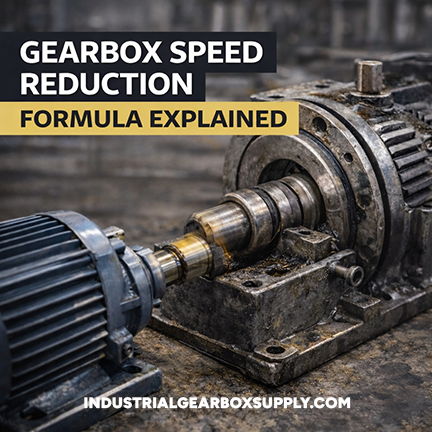
Many gearbox selection problems stem from misunderstanding speed reduction ratios and how they affect performance. This article explains the gearbox speed reduction formula, how to use it correctly, and how it ties directly into torque and reliability.
What Is Gearbox Speed Reduction?
Gearbox speed reduction refers to the decrease in rotational speed between the input shaft (usually driven by a motor) and the output shaft.
When speed is reduced, torque increases. This tradeoff is the fundamental purpose of a gearbox in power transmission systems.
Speed reduction is expressed as a ratio, such as:
10:1
20:1
30:1
A 20:1 reduction means the input shaft rotates 20 times for every 1 rotation of the output shaft.
The Basic Gearbox Speed Reduction Formula
The most common formula for calculating output speed is:
Output Speed (RPM) = Input Speed (RPM) ÷ Gear Ratio
This formula applies to all gearbox types, including helical, bevel, planetary, and worm gearboxes.
Example
Motor speed = 1,750 RPM
Gear ratio = 25:1
Output speed = 1,750 ÷ 25
= 70 RPM
This means the gearbox output shaft will rotate at approximately 70 RPM under ideal conditions.
Calculating Gear Ratio From Input and Output Speed
If you know both input and output speed, you can calculate the gear ratio:
Gear Ratio = Input Speed (RPM) ÷ Output Speed (RPM)
Example
Input speed = 1,750 RPM
Output speed = 35 RPM
Gear ratio = 1,750 ÷ 35
= 50:1
This indicates a 50:1 speed reduction gearbox.
Speed Reduction and Torque Relationship
Speed reduction directly increases torque.
The relationship is:
Torque Increase ≈ Gear Ratio × Efficiency
As speed decreases, torque increases by roughly the same ratio, minus efficiency losses.
This is why speed reduction calculations should always be paired with torque calculations when selecting a gearbox.
Accounting for Gearbox Efficiency
Real-world gearboxes are not 100% efficient.
Typical efficiencies:
Helical and bevel gearboxes: ~94–98%
Planetary gearboxes: ~95–98%
Worm gearboxes: varies widely (often 50–90%)
Efficiency affects torque output more than speed output, but it should still be considered when sizing gearboxes.
Output speed remains close to the calculated value, but load conditions can cause minor variations.
Multi-Stage Gearbox Speed Reduction
Many industrial gearboxes use multiple gear stages to achieve higher reductions.
In multi-stage gearboxes, the total ratio is the product of each stage.
Example
First stage: 5:1
Second stage: 6:1
Total ratio = 5 × 6
= 30:1
Output speed = Input speed ÷ 30
Multi-stage designs allow compact gearboxes to achieve high torque and low output speeds.
Worm Gearbox Speed Reduction
Worm gearboxes achieve speed reduction differently than parallel-shaft gearboxes.
In worm gearboxes, the ratio is often determined by:
Number of teeth on the worm wheel
Number of starts on the worm
Example
Single-start worm with a 40-tooth worm wheel:
Gear ratio = 40:1
Worm gearboxes excel at high reduction ratios but may sacrifice efficiency, especially at higher ratios.
Common Mistakes With Speed Reduction Calculations
Several common errors lead to incorrect gearbox selection:
Confusing ratio direction (multiplying instead of dividing RPM)
Ignoring load and torque requirements
Assuming efficiency does not matter
Using motor synchronous speed instead of actual operating speed
Forgetting service factor and duty cycle
Speed reduction should never be calculated in isolation.
Practical Application: Choosing the Right Output Speed
Correct output speed depends on the driven equipment.
Conveyors, mixers, agitators, and positioning systems all require specific speed ranges. Overspeeding can damage equipment, while underspeeding can reduce productivity or cause stalling.
Matching speed reduction to the application ensures smooth operation and long gearbox life.
How Speed Reduction Affects Gearbox Life
Excessive speed reduction without proper torque rating can overload gear teeth and bearings.
Likewise, operating a gearbox at higher speeds than intended increases heat, vibration, and wear.
Proper speed reduction selection balances speed, torque, efficiency, and service factor.
Final Thoughts
Gearbox speed reduction is one of the most fundamental calculations in power transmission. Using the correct speed reduction formula ensures that output speed matches application requirements while maintaining reliability.
When speed reduction is calculated correctly and paired with proper torque and service factor calculations, gearbox failures become far less likely.
If you need help selecting the right gearbox ratio or confirming speed reduction for your application, IndustrialGearboxSupply.com can help you determine the correct solution.