

How to Calculate Gearbox Torque (Step-by-Step)
Knowing how to calculate gearbox torque is essential for selecting the right gearbox, preventing overload, and ensuring reliable performance. Torque calculations help you confirm whether a gearbox can handle your load, choose the correct service factor, and avoid common failure causes like overheating, bearing damage, and broken gear teeth.
This step-by-step guide shows the most common gearbox torque calculations used in industrial applications, along with practical examples.
What Is Gearbox Torque?
Torque is a twisting force that turns a shaft. In power transmission, torque is what actually “does the work” at the gearbox output.
Gearbox torque is typically discussed in two ways:
Input torque (torque going into the gearbox from the motor)
Output torque (torque delivered by the gearbox to the driven equipment)
Gearboxes trade speed for torque. When speed goes down, torque goes up (minus efficiency losses).
The 3 Numbers You Need
To calculate gearbox torque, you usually need:
Power (horsepower or kilowatts)
Speed (RPM)
Gear ratio (or input and output RPM)
You may also need:
Efficiency (especially for worm gearboxes)
Service factor (for real-world loading)
Step 1: Calculate Motor Input Torque From Horsepower and RPM
If you have horsepower and motor RPM, use this formula:
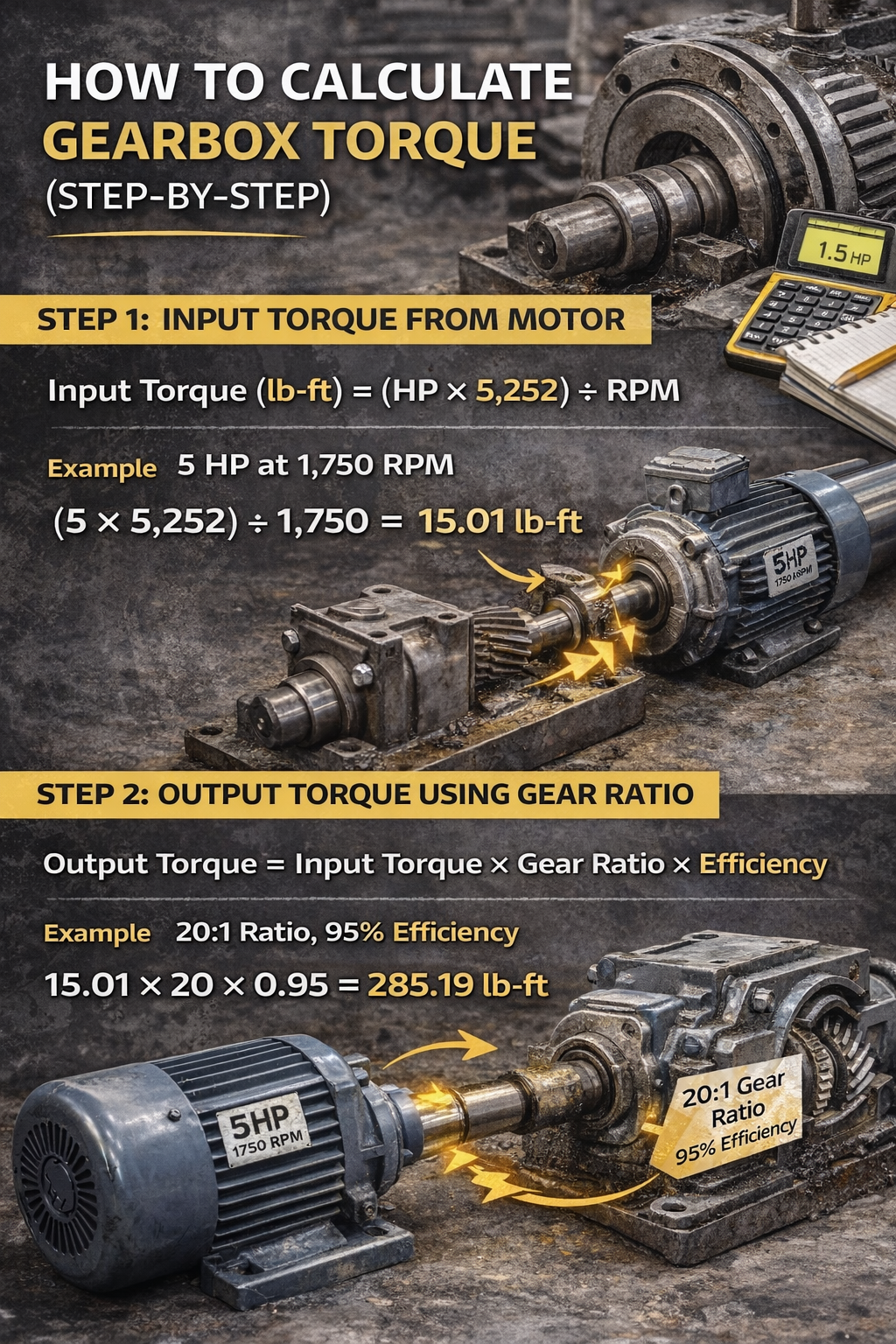
Input Torque (lb-in) = (HP × 63,025) ÷ RPM
Or if you prefer lb-ft:
Input Torque (lb-ft) = (HP × 5,252) ÷ RPM
Example
Motor = 5 HP at 1,750 RPM
Input torque (lb-ft) = (5 × 5,252) ÷ 1,750
= 26,260 ÷ 1,750
= 15.01 lb-ft (approx.)
Step 2: Calculate Output Torque Using Gear Ratio
Once you have input torque, multiply by the gear ratio and efficiency.
Output Torque = Input Torque × Gear Ratio × Efficiency
Efficiency is usually:
Helical / bevel: ~0.94 to 0.98
Planetary: ~0.95 to 0.98
Worm: can be much lower depending on ratio and design (~0.50 to 0.90)
Example
Using the same 5 HP motor, with a 20:1 gearbox and 95% efficiency (0.95):
Output torque (lb-ft) = 15.01 × 20 × 0.95
= 15.01 × 19
= 285.19 lb-ft (approx.)
Step 3: Calculate Output Torque Directly From Output RPM
If you know output RPM instead of gear ratio, you can calculate output torque directly from horsepower:
Output Torque (lb-ft) = (HP × 5,252 × Efficiency) ÷ Output RPM
Example
5 HP gearbox output speed = 87.5 RPM (which matches a 20:1 ratio from 1,750 RPM)
Efficiency = 0.95
Output torque (lb-ft) = (5 × 5,252 × 0.95) ÷ 87.5
= (26,260 × 0.95) ÷ 87.5
= 24,947 ÷ 87.5
= 285.11 lb-ft (approx.)
Step 4: Convert Torque Units (Common Conversions)
Many gearboxes list torque in Nm instead of lb-ft.
1 lb-ft = 1.356 Nm
1 Nm = 0.7376 lb-ft
1 lb-in = 0.113 lb-ft
Example
285 lb-ft × 1.356 = 386.5 Nm (approx.)
Step 5: Apply Service Factor for Real-World Loads
Torque calculations above are “ideal.” Real applications have shock loads, starts/stops, and duty cycle stress.
That’s why gearboxes use a service factor (SF).
Required Torque = Calculated Output Torque × Service Factor
Common service factors:
Light duty: 1.0–1.25
Moderate duty: 1.25–1.5
Heavy shock/reversing: 1.75–2.0+
Example
Output torque = 285 lb-ft
Service factor = 1.5
Required torque rating = 285 × 1.5 = 427.5 lb-ft
Your gearbox should be rated above 427.5 lb-ft for that application.
Step 6: Check Gearbox Output Shaft and Coupling Ratings
Even if gearbox torque rating is sufficient, the output shaft and coupling must also handle the torque.
Always verify:
Output shaft size and material rating
Keyway rating
Coupling rating
Mounting rigidity and alignment
Underrated couplings and misalignment often cause failures even when torque calculations are correct.
Common Mistakes When Calculating Gearbox Torque
Ignoring efficiency (especially on worm gearboxes)
Using motor nameplate HP when the motor is oversized or underloaded
Forgetting service factor
Confusing lb-in and lb-ft
Using “ratio” without confirming true output RPM under load
Quick Torque Calculation Summary
Input torque from motor:
T_in (lb-ft) = (HP × 5,252) ÷ RPMOutput torque from ratio:
T_out = T_in × Ratio × EfficiencyOutput torque from output RPM:
T_out (lb-ft) = (HP × 5,252 × Efficiency) ÷ Output RPMRequired rating with service factor:
T_required = T_out × SF
Final Thoughts
Calculating gearbox torque is the foundation of selecting the correct gearbox for industrial equipment. When torque is calculated correctly and service factor is applied, you reduce the risk of overheating, gear wear, bearing failure, and premature breakdown.
If you want help calculating gearbox torque for your exact application, IndustrialGearboxSupply.com can help you verify torque requirements and recommend the right gearbox type and size.