

Gearboxes for Conveyors: Selection and Common Failures
Conveyors are one of the most common industrial applications for gearboxes, yet they are also one of the most frequently misapplied. Incorrect gearbox selection is a leading cause of conveyor downtime, excessive wear, and premature failure.
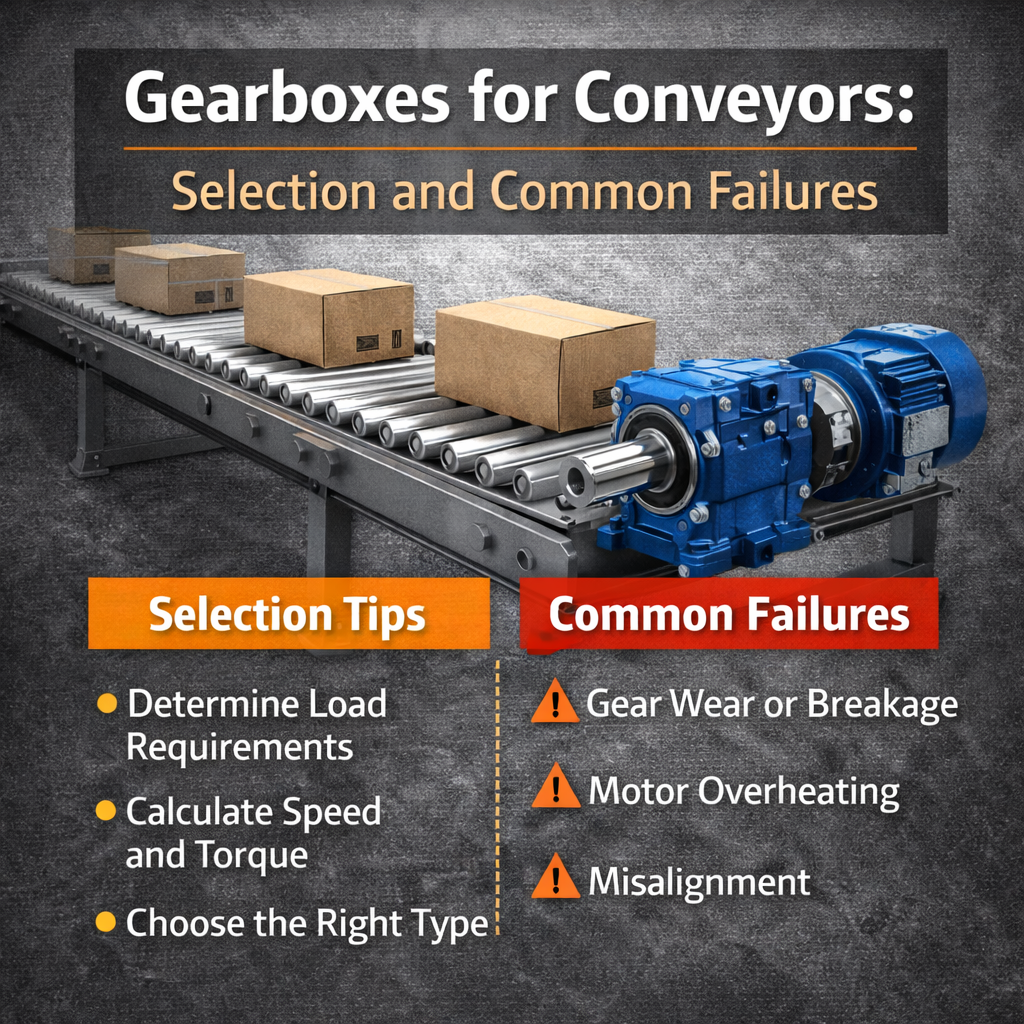
This article explains how to properly select gearboxes for conveyors and outlines the most common failure modes seen in real-world conveyor systems.
Why Conveyor Gearbox Selection Matters
Conveyors operate under unique conditions compared to many other driven systems.
They often experience:
Continuous duty cycles
Heavy loads
Frequent starts and stops
Shock loading
Overhung loads from pulleys or sprockets
A gearbox that is incorrectly sized or poorly matched to these conditions will fail far sooner than expected.
Key Factors When Selecting a Gearbox for Conveyors
Proper selection starts with understanding the conveyor’s operating requirements.
Required Output Speed
The required output speed is determined by belt speed, roller diameter, or chain pitch.
Conveyor speed must be calculated accurately before selecting a gearbox ratio. Overspeeding can cause material spillage, while underspeeding reduces throughput.
Torque Requirements
Conveyors often require high starting torque, especially when starting under load.
Torque calculations must account for:
Conveyor length
Load weight
Incline or decline
Friction
Starting conditions
Starting torque is often significantly higher than running torque.
Service Factor and Duty Cycle
Conveyors rarely operate under perfectly smooth conditions.
Service factor must account for:
Shock loading
Frequent starts
Reversing operation
Continuous or near-continuous runtime
Underestimating service factor is one of the most common conveyor gearbox selection mistakes.
Overhung Load
Many conveyors apply overhung loads to the gearbox output shaft through belt drives, chain drives, or sprockets.
Overhung load creates bending forces that must be considered when selecting shaft size and bearing capacity.
Ignoring overhung load leads to bearing and shaft failures.
Mounting Orientation
Conveyor gearboxes are often mounted horizontally, vertically, or shaft-mounted.
Mounting orientation affects:
Lubrication distribution
Bearing loading
Seal performance
The gearbox must be approved for the intended mounting position.
Common Gearbox Types Used on Conveyors
Several gearbox designs are commonly used for conveyor applications.
Helical Gearboxes
Helical gearboxes are widely used due to their:
High efficiency
Smooth operation
Good load capacity
They are suitable for most conveyor applications, especially where efficiency and noise reduction are important.
Bevel and Helical-Bevel Gearboxes
Bevel and helical-bevel gearboxes are used when right-angle power transmission is required.
They offer good efficiency and are common in space-constrained conveyor layouts.
Shaft-Mounted Gearboxes
Shaft-mounted gearboxes are popular for belt and chain conveyors.
They eliminate couplings and reduce alignment requirements but must be properly sized for overhung load and torque.
Worm Gearboxes
Worm gearboxes are sometimes used for low-speed conveyors.
However, their lower efficiency and heat generation make them less suitable for continuous-duty or high-load conveyors.
Common Conveyor Gearbox Failures
Most conveyor gearbox failures follow predictable patterns.
Overloading and Undersizing
Undersized gearboxes are often selected based on running torque rather than starting torque.
Repeated overloads during startup cause gear tooth fatigue, bearing damage, and eventual failure.
Bearing Failures
Bearing failures are extremely common in conveyor gearboxes.
Causes include:
Excessive overhung load
Misalignment
Contamination
Insufficient lubrication
Bearing failure often leads to secondary gear and seal damage.
Seal Failures and Oil Leaks
Conveyor environments are often dusty, dirty, or wet.
Seal failures allow lubricant loss and contamination, accelerating internal wear.
Blocked breathers also cause pressure buildup that forces oil past seals.
Misalignment
Misalignment between motor, gearbox, and conveyor drive components creates uneven loading.
Misalignment leads to vibration, bearing wear, and shaft fatigue.
Lubrication Problems
Incorrect oil viscosity, contamination, or extended oil change intervals are major contributors to failure.
Conveyor gearboxes often operate continuously, making proper lubrication critical.
Thermal Overload
Heat buildup occurs when gearboxes are undersized, overloaded, or inefficient.
Thermal overload breaks down lubricant and reduces bearing life.
Early Warning Signs of Conveyor Gearbox Problems
Conveyor gearbox issues rarely appear without warning.
Common early indicators include:
Rising operating temperature
Increased noise or vibration
Oil leaks
Metal particles in oil
Increased motor current draw
Monitoring these signs helps prevent catastrophic failure.
Preventing Conveyor Gearbox Failures
Proper selection and maintenance significantly reduce failure risk.
Best practices include:
Accurate torque and speed calculations
Applying appropriate service factor
Accounting for overhung load
Selecting the correct gearbox type
Using proper lubrication
Maintaining seals and breathers
Performing routine inspections
Preventive maintenance is far less costly than unplanned downtime.
When to Upgrade or Replace a Conveyor Gearbox
A gearbox should be upgraded or replaced when:
Load requirements increase
Operating conditions change
Failure rates become frequent
Efficiency losses increase energy cost
Replacing an undersized gearbox with a properly selected unit often improves reliability immediately.
Final Thoughts
Conveyors place demanding requirements on gearboxes, making correct selection critical.
Most conveyor gearbox failures are caused by undersizing, improper service factor, overhung load, or poor lubrication.
Understanding conveyor-specific requirements and common failure modes helps extend gearbox life and reduce downtime.
If you need help selecting or troubleshooting a gearbox for a conveyor application, IndustrialGearboxSupply.com can help guide you toward the right solution.