

Gearboxes for Mixers and Agitators
Mixers and agitators place some of the most demanding loads on industrial gearboxes. Unlike conveyors or pumps, mixers often operate under variable load conditions, high torque, and frequent shock loading. Selecting the wrong gearbox for a mixer or agitator is a common cause of overheating, excessive wear, and premature failure.
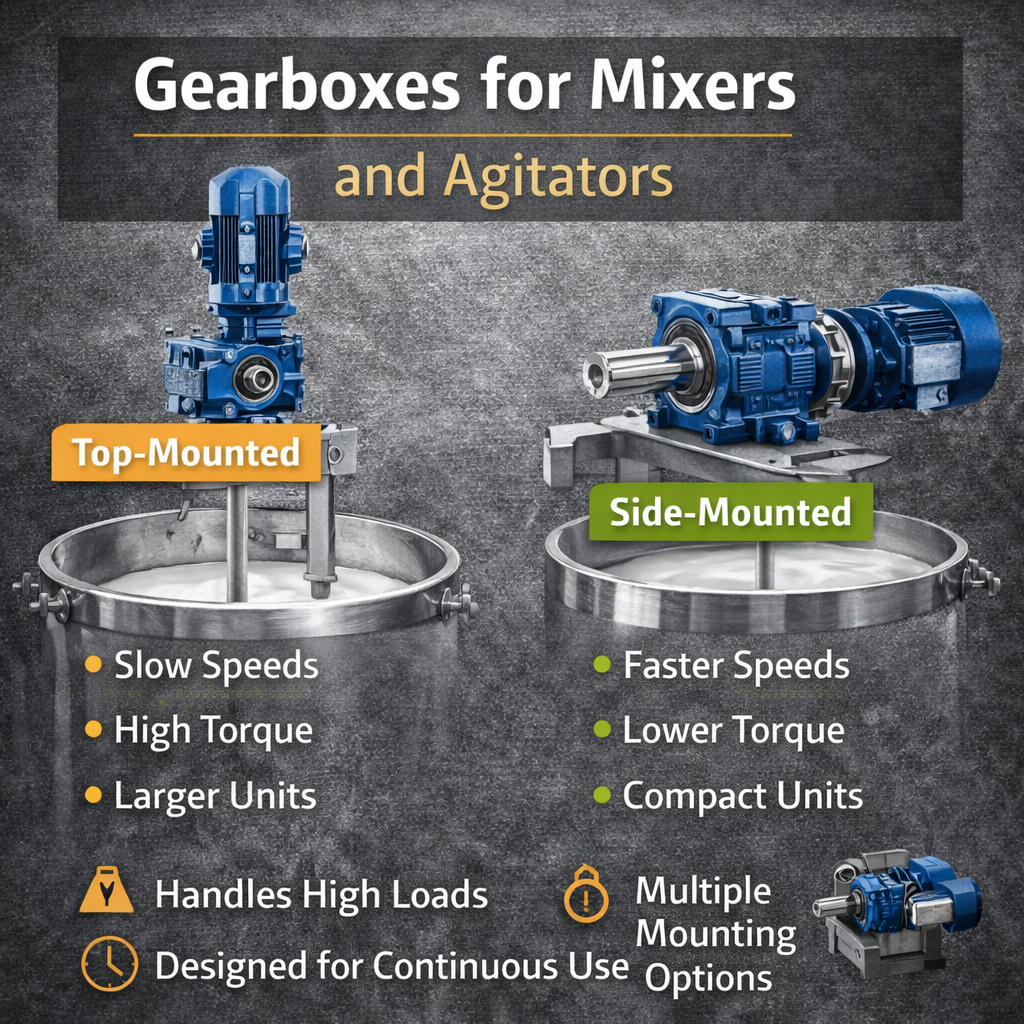
This article explains how to properly select gearboxes for mixers and agitators and highlights the most common failure modes seen in these applications.
Why Mixer and Agitator Gearbox Selection Is Critical
Mixers and agitators are designed to move, blend, or suspend materials inside tanks or vessels. Load conditions change constantly depending on material viscosity, fill level, and process conditions.
Gearboxes in these applications often experience:
High starting torque
Variable and unpredictable loads
Shock loading from material movement
Continuous or extended duty cycles
High axial and radial forces
These factors make gearbox selection more critical than in many other applications.
Key Operating Characteristics of Mixers and Agitators
Understanding how the mixer operates is essential before selecting a gearbox.
Variable Load Conditions
Unlike conveyors with relatively steady loads, mixers experience changing resistance as material properties change.
Viscosity, temperature, and batch composition all affect torque demand. Gearboxes must be sized for worst-case loading, not average conditions.
High Starting Torque
Mixers often start under load, especially when material has settled or thickened.
Starting torque can be significantly higher than running torque, and undersizing the gearbox leads to gear tooth fatigue and bearing damage.
Low Speed, High Torque Operation
Most mixers and agitators operate at relatively low output speeds but require very high torque.
This combination places extreme stress on gears, shafts, and bearings and requires robust gearbox designs.
Gearbox Types Commonly Used for Mixers and Agitators
Several gearbox designs are commonly used depending on application requirements.
Helical Gearboxes
Helical gearboxes are widely used for mixers due to their:
High efficiency
Smooth torque transmission
Good load capacity
They perform well in moderate to heavy mixing applications where efficiency and durability are important.
Bevel and Helical-Bevel Gearboxes
Bevel and helical-bevel gearboxes are used when right-angle power transmission is required.
They are common in top-mounted mixer designs and applications with space constraints.
Planetary Gearboxes
Planetary gearboxes are ideal for high-torque mixer applications.
They offer:
High torque density
Compact size
Excellent load sharing
Planetary designs are often used in heavy-duty and high-viscosity mixing applications.
Shaft-Mounted and Flange-Mounted Designs
Mixers may use flange-mounted gearboxes or shaft-mounted configurations depending on vessel design.
Mounting style affects bearing loading, shaft support, and alignment requirements.
Key Selection Factors for Mixer and Agitator Gearboxes
Correct selection goes beyond speed and ratio.
Required Output Speed
Mixer speed depends on impeller size, tank diameter, and process requirements.
Accurate speed calculation is essential to avoid poor mixing performance or excessive power consumption.
Torque and Service Factor
Mixer gearboxes must be selected with generous service factors.
Shock loading, variable viscosity, and batch processes demand higher service factors than steady-state applications.
Underestimating service factor is a leading cause of mixer gearbox failure.
Axial and Radial Loads
Mixers generate significant axial thrust from impellers, especially in vertical configurations.
Gearboxes must be rated for these loads, and bearing selection must account for thrust forces.
Ignoring axial loads leads to rapid bearing wear.
Thermal Capacity
High torque and continuous operation generate heat.
Gearboxes must be capable of dissipating heat under worst-case conditions. Inadequate thermal capacity results in lubricant breakdown and overheating.
Lubrication Requirements
Proper lubricant selection is critical.
Many mixers operate in food, chemical, or washdown environments that require specific lubricant types, including food-grade oils.
Incorrect lubrication accelerates wear and reduces efficiency.
Common Gearbox Failures in Mixers and Agitators
Most failures stem from predictable causes.
Overloading
Undersized gearboxes fail due to repeated overload during startup or high-viscosity mixing.
Overloading causes gear tooth pitting, bearing damage, and shaft fatigue.
Bearing Failures
High axial and radial loads frequently lead to bearing failure.
Bearing issues often cascade into gear misalignment and secondary damage.
Seal Failures and Contamination
Mixer environments are often wet, corrosive, or contaminated.
Seal failure allows lubricant loss and contaminant ingress, rapidly degrading internal components.
Misalignment
Poor alignment between motor, gearbox, and mixer shaft increases vibration and bearing wear.
Misalignment is especially damaging in vertical mixer installations.
Lubrication Breakdown
Extended duty cycles and high temperatures degrade lubricant.
Once lubrication fails, wear accelerates rapidly.
Early Warning Signs of Mixer Gearbox Problems
Mixer gearbox failures usually provide warning signs.
Common indicators include:
Rising operating temperature
Increased noise or vibration
Oil leaks
Reduced mixing performance
Increased motor current draw
Early detection allows corrective action before catastrophic failure.
Preventing Gearbox Failures in Mixers
Proper selection and maintenance significantly extend gearbox life.
Best practices include:
Sizing for worst-case torque
Applying high service factors
Selecting gearboxes rated for axial loads
Using correct lubricant type and viscosity
Monitoring temperature and vibration
Inspecting seals and breathers regularly
Preventive maintenance is especially important in mixer applications.
When to Upgrade or Replace a Mixer Gearbox
A gearbox should be upgraded or replaced when:
Process requirements change
Material viscosity increases
Failures become frequent
Energy consumption rises
Mixing performance degrades
Replacing an undersized gearbox often immediately improves reliability.
Final Thoughts
Mixers and agitators place heavy, variable loads on gearboxes, making proper selection essential.
Most mixer gearbox failures result from undersizing, inadequate service factor, unaccounted axial loads, or lubrication problems.
Understanding mixer-specific requirements helps prevent downtime and extend gearbox life.
If you need help selecting or troubleshooting a gearbox for a mixer or agitator application, IndustrialGearboxSupply.com can help guide you toward the right solution.