

How Misalignment Damages Gearboxes Over Time
Misalignment is one of the most common and destructive conditions affecting industrial gearboxes. While its effects may not be immediately obvious, misalignment causes gradual damage that compounds over time, leading to premature wear, efficiency loss, and eventual gearbox failure.
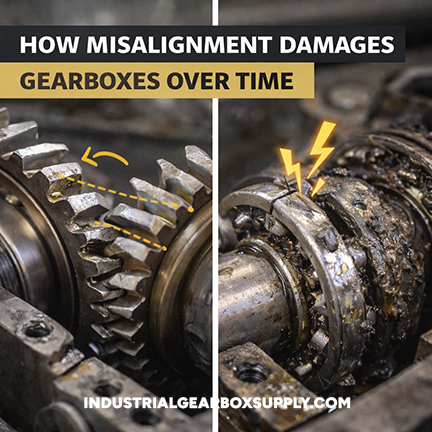
Many gearbox failures blamed on bearings, lubrication, or load issues can ultimately be traced back to misalignment. Understanding how misalignment damages gearboxes over time is critical for preventing avoidable failures and extending equipment life.
This guide explains what misalignment is, how it develops, and the long-term damage it causes inside a gearbox.
What Is Gearbox Misalignment?
Gearbox misalignment occurs when the input shaft, output shaft, motor, or driven equipment are not positioned in the correct geometric relationship.
Misalignment can be:
Angular (shafts are at an angle to each other)
Parallel (offset) (shafts are parallel but not centered)
Combined (both angular and parallel misalignment)
Even small alignment errors introduce forces that gearboxes are not designed to handle continuously.
Why Misalignment Is So Damaging Over Time
Gearboxes are designed to operate with even load distribution across gears and bearings. Misalignment disrupts this balance.
Instead of load being shared evenly, misalignment concentrates stress on specific areas of gear teeth, bearing races, and seals. This uneven loading accelerates wear and reduces component life long before obvious symptoms appear.
The damage from misalignment is progressive, meaning it worsens with every hour of operation.
How Misalignment Affects Gear Teeth
Misalignment causes uneven gear tooth contact.
Instead of full-face contact, gear teeth engage on a limited portion of the tooth surface. This increases contact stress,z increases sliding friction, and accelerates surface fatigue.
Over time, misaligned gear contact leads to:
Pitting and spalling
Scoring and scuffing
Uneven wear patterns
Increased backlash
Once gear tooth damage begins, wear accelerates rapidly.
How Misalignment Damages Bearings
Bearings are especially vulnerable to misalignment.
Misalignment causes bearings to carry loads they were not designed for, including excessive axial or radial forces. This increases rolling resistance and accelerates fatigue.
Bearing damage from misalignment often appears as:
Early spalling
Overheating
Increased vibration
Reduced bearing life
Bearing failure is often one of the earliest visible consequences of misalignment.
Seal Wear and Lubricant Loss
Misalignment causes shaft movement and vibration that damage seals.
As seals wear unevenly, lubricant leaks develop. Oil loss leads to reduced lubrication, increased contamination risk, and rising operating temperatures.
Seal failure is frequently treated as the primary problem, when in reality it is a symptom of underlying misalignment.
Increased Vibration and Noise
Misalignment is a major source of abnormal vibration.
As rotating components fight against improper alignment, vibration amplitude increases. This vibration further accelerates wear in gears, bearings, and seals.
Noise often increases gradually, starting as a faint hum or whine and progressing to grinding or knocking sounds.
Heat Buildup and Efficiency Loss
Misalignment increases internal friction.
As friction rises, more energy is converted into heat rather than useful output. This leads to higher operating temperatures and reduced gearbox efficiency.
Heat accelerates lubricant breakdown, which further increases wear and compounds the damage cycle.
Why Misalignment Gets Worse Over Time
Misalignment rarely stays constant.
As components wear, bearings loosen, foundations settle, and thermal expansion occurs, alignment conditions often worsen. What begins as a minor misalignment can evolve into a severe condition if not corrected.
This is why gearboxes may run acceptably at first but fail prematurely months or years later.
Common Causes of Gearbox Misalignment
Misalignment often results from:
Improper installation
Uneven or flexible mounting surfaces
Thermal growth not accounted for
Shaft deflection under load
Loose mounting hardware
Foundation settling
Poor coupling selection
Misalignment can also develop after maintenance if alignment is not rechecked.
How to Detect Misalignment Early
Early detection is critical.
Warning signs include:
Rising vibration levels
Uneven or repeating bearing failures
Increased operating temperature
Abnormal noise
Repeated seal leaks
Declining efficiency
Laser alignment tools, vibration analysis, and thermal imaging are effective ways to identify misalignment before severe damage occurs.
Preventing Misalignment Damage
Preventing misalignment damage starts with proper installation.
Use precision alignment tools and verify alignment under operating conditions when possible. Ensure mounting surfaces are flat, rigid, and properly supported.
Recheck alignment after initial startup and during scheduled maintenance. Account for thermal growth and shaft deflection in high-load applications.
Correct coupling selection also helps accommodate minor movement without transferring stress to the gearbox.
When Misalignment Damage Requires Replacement
In some cases, misalignment damage has progressed too far for correction.
Replacement may be necessary when gear tooth wear is advanced, bearings repeatedly fail, or housings are distorted.
Correcting alignment without addressing existing internal damage may not restore reliability.
Final Thoughts
Misalignment is a silent but powerful cause of gearbox damage. Its effects develop gradually, often going unnoticed until failure occurs.
Understanding how misalignment damages gearboxes over time allows maintenance teams to take early corrective action, extend gearbox life, and avoid costly downtime.
If you need help evaluating alignment issues or selecting a gearbox designed to handle your application, IndustrialGearboxSupply.com can help guide you toward the right solution.