

How to Size a Motor for Your Application: Step-by-Step Guide
Choosing the right motor for your equipment isn’t just about horsepower—it’s about ensuring long-term reliability, efficiency, and performance.
In this guide, we break down how to size an electric motor correctly, what factors matter most, and how to avoid common mistakes that cost time and money.
Why Proper Motor Sizing Matters
A motor that's too small will overheat and wear out faster. One that's too large may cost more and operate inefficiently. Proper motor sizing helps you:
Avoid overloads and downtime
Improve energy efficiency
Extend equipment life
Match torque and speed requirements precisely
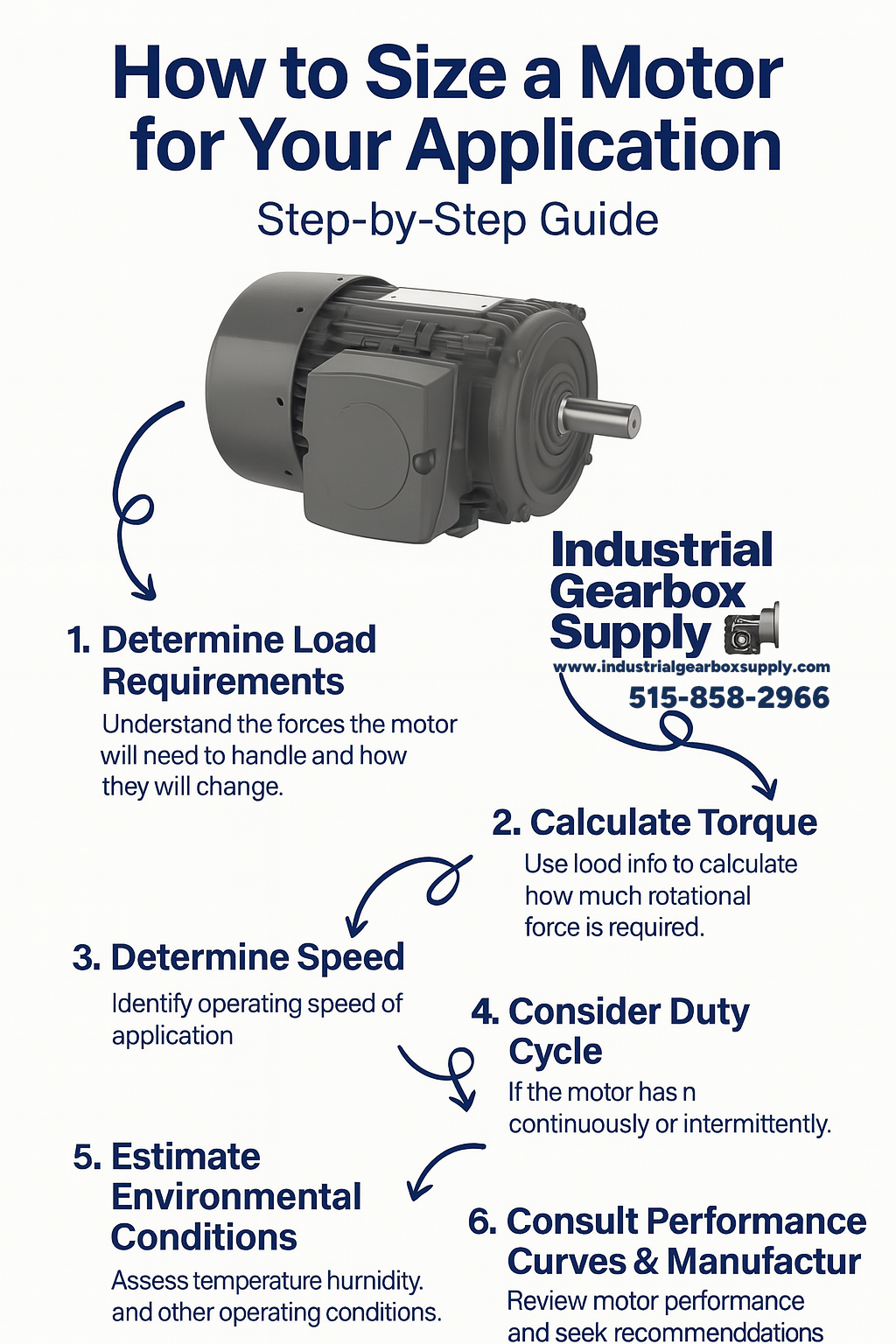
Step 1: Define the Application Requirements
Start by answering these key questions:
What is the load type (constant, variable, shock)?
What is the required speed (RPM)?
What torque is needed at startup and during continuous operation?
What is the duty cycle (continuous, intermittent, etc.)?
What environment will the motor operate in (temperature, humidity, exposure)?
Step 2: Calculate Required Torque and Horsepower
Use basic formulas or our Gearbox Torque Calculator to determine:
Torque (lb-ft or Nm)
Horsepower (HP = (Torque x RPM) / 5252)
Safety factor (typically 1.25–1.5 for industrial motors)
If your motor connects to a gearbox, make sure to factor in gear reduction.
Step 3: Select the Motor Type
Based on your torque and load needs, choose the right motor category:
AC Motors: Simple, durable, low maintenance
DC Motors: Precise speed control, often used in mobile or battery-powered systems
Servo Motors: High precision and fast response
Stepper Motors: Ideal for short, repeated motion tasks
Step 4: Choose the Correct NEMA Frame and Mounting
Use our NEMA Frame Finder Tool to:
Match your motor to the proper shaft height and mounting bolt pattern
Ensure drop-in compatibility for replacements or retrofits
Mounting types include foot-mount, C-face, D-flange, and vertical.
Step 5: Match Voltage and Phase Requirements
Verify power compatibility:
Available voltage (e.g., 230V, 460V, 575V)
Use our Voltage & Phase Compatibility Checker to confirm alignment with your facility.
Step 6: Choose the Right Enclosure and Protection Rating
Environment matters. Choose the right enclosure:
TEFC (Totally Enclosed Fan Cooled) for dusty/dirty environments
ODP (Open Drip Proof) for clean, dry indoor areas
Explosion Proof for hazardous zones
Use our Motor Enclosure Type Explainer and IP Rating Lookup Tool to help you decide.
Step 7: Confirm Service Factor and Efficiency Ratings
Service Factor (SF) allows occasional overload capacity
Efficiency Ratings (e.g., NEMA Premium®) reduce energy consumption and qualify for rebates
High-efficiency motors may have slightly higher upfront costs but deliver big savings long term.
Common Motor Sizing Mistakes to Avoid
Guessing instead of calculating torque and speed
Ignoring startup load requirements
Overlooking duty cycle and runtime environment
Using wrong enclosure in dusty or wet environments
Mismatching frame size with mounting hardware
Use Our Free Motor Tools to Simplify the Process
Need personalized help? Call our experts at (517) 858-2966 or email sales@industrialgearboxsupply.com.
FAQ
What happens if I oversize a motor?
It may run inefficiently, waste energy, and require more expensive control hardware.
Can I use a three-phase motor in a single-phase facility?
Not directly—you may need a phase converter or VFD (Variable Frequency Drive).
How do I calculate the required horsepower for my machine?
Use the formula HP = (Torque x RPM) / 5252 or our online torque calculator.
What’s the difference between TEFC and ODP motors?
TEFC motors are enclosed and ideal for dusty environments, while ODP motors are better for clean indoor use.
Industrial Gearbox Supply makes motor sizing simple. Use our free tools or call us at (517) 858-2966 for expert assistance.