

Helical vs Worm vs Planetary Gearboxes: Which One Is Right for You?
Choosing the right gearbox for your application can mean the difference between efficient operation and costly downtime. Among the most common gearbox types—helical, worm, and planetary—each offers unique benefits.
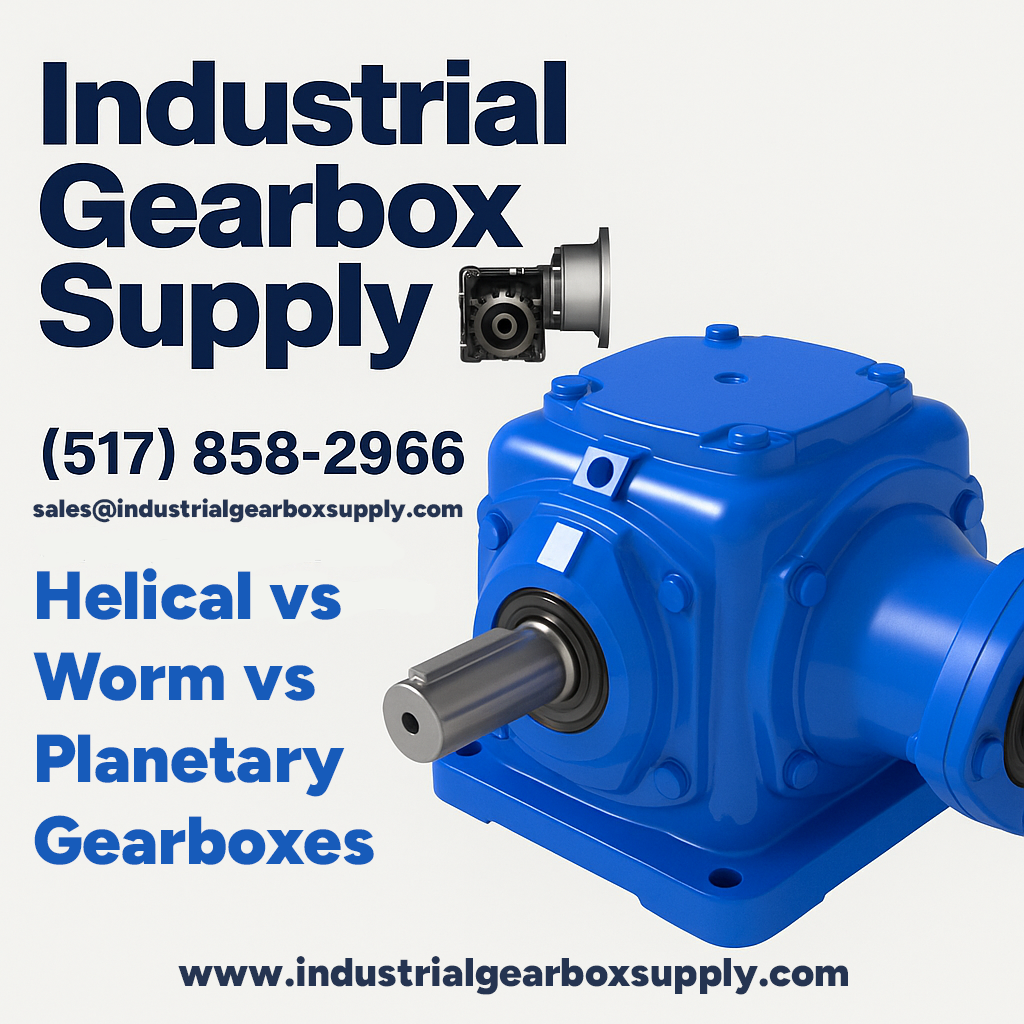
In this guide, we’ll help you understand the pros, cons, and ideal use cases of each to make the best decision for your system.
What Are the Main Types of Gearboxes?
Gearboxes are mechanical devices that transmit torque and adjust speed between a motor and the load. The three most common types in industrial applications are:
Helical gearboxes: Use angled teeth for smooth, continuous engagement.
Worm gearboxes: Use a screw-like worm to drive a toothed wheel.
Planetary gearboxes: Use a central sun gear surrounded by planet gears inside a ring.
Each type serves a specific purpose depending on torque needs, footprint, cost, and precision.
Helical Gearboxes: Quiet and Efficient
How they work: Helical gearboxes use angled teeth that engage gradually, distributing load more evenly.
Benefits:
High efficiency (up to 98%)
Smooth, quiet operation
Strong torque handling
Longer service life due to reduced wear
Drawbacks:
Larger and heavier
Typically more expensive than worm gearboxes
Best for:
Conveyors
Packaging equipment
Industrial mixers
Material handling systems
Worm Gearboxes: Compact and Cost-Effective
How they work: A worm (threaded shaft) drives a worm wheel, producing high gear reduction in compact space.
Benefits:
Self-locking in some ratios
Very compact design
Affordable option for simple motion control
Drawbacks:
Low efficiency (50–70%) due to friction
Generates more heat
Wears out faster under continuous heavy loads
Best for:
Basic automation
Lifts and hoists
Simple conveyors
Gate or door operators
Planetary Gearboxes: High Torque in a Small Package
How they work: A sun gear drives three or more planet gears, which rotate inside an outer ring gear. The load is evenly distributed across the planets.
Benefits:
Extremely high torque-to-size ratio
Compact and lightweight
High efficiency and precision
Drawbacks:
More complex design
Higher cost
Best for:
Robotics
Precision automation
Servo motor applications
Aerospace and medical devices
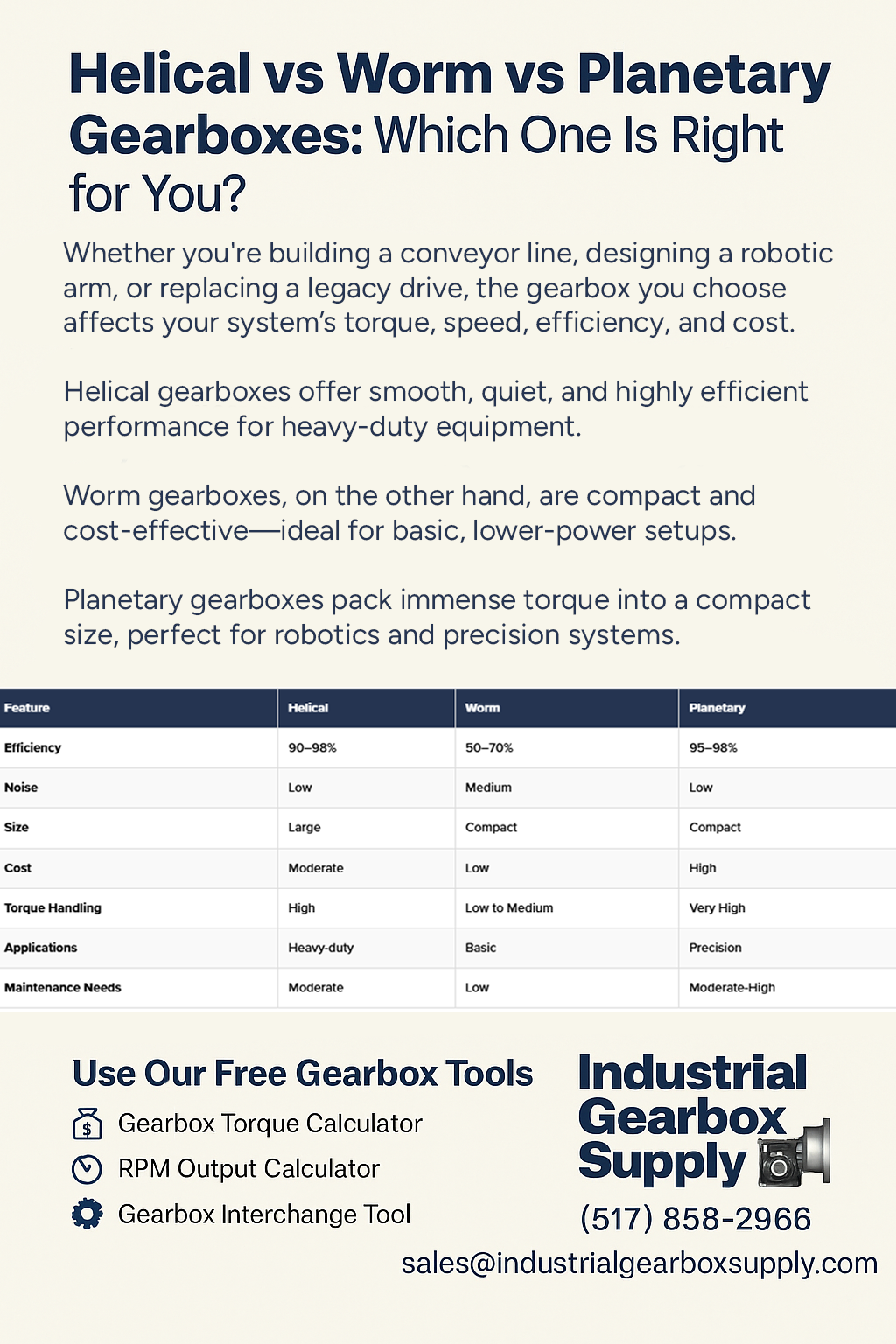
Comparison Table: Helical vs Worm vs Planetary
| Feature | Helical | Worm | Planetary |
|---|---|---|---|
| Efficiency | 90–98% | 50–70% | 95–98% |
| Noise | Low | Medium | Low |
| Size | Large | Compact | Compact |
| Cost | Moderate | Low | High |
| Torque Handling | High | Low to Medium | Very High |
| Applications | Heavy-duty | Basic | Precision |
| Maintenance Needs | Moderate | Low | Moderate-High |
How to Choose the Right Gearbox
Choosing the right gearbox depends on:
Torque requirements
Precision
Available space
Budget
Duty cycle
Environmental conditions
If you're unsure, use tools like:
Gearbox Torque Calculator
RPM Output Calculator
Gearbox Interchange Tool
Use Our Free Gearbox Tools
Make your decision easier with our suite of free calculators and tools:
Gearbox Torque Calculator — Size gearboxes correctly for your load.
RPM Output Calculator — Ensure proper speed delivery.
Gearbox Interchange Tool — Find drop-in replacements instantly.
Need help choosing the right gearbox? Contact our team or call us at (517) 858-2966.
FAQ
What is the difference between a helical and worm gearbox?
Helical gearboxes offer higher efficiency and quieter operation. Worm gearboxes are more compact and self-locking but have lower efficiency.
When should I use a planetary gearbox?
Planetary gearboxes are ideal when space is limited, but high torque and precision are required, such as in robotics or servo-driven applications.
Which gearbox type is most energy efficient?
Helical and planetary gearboxes are both highly efficient, often reaching up to 98%, making them suitable for continuous-duty industrial applications.