

NEMA Enclosure Types: What They Mean and Why They Matter
When selecting an electric motor for your application, one of the most overlooked but critical factors is the enclosure type. The NEMA enclosure rating tells you how well the motor is protected from dust, water, and environmental hazards. Choosing the wrong enclosure can lead to equipment failure, safety issues, and unnecessary downtime.
This guide explains the most common NEMA enclosure types, what the ratings mean, and how to choose the right one for your environment.
Recommended: Check out our NEMA Motors to find the best one for your application. Call us for one-on-one expert help.
What Is a NEMA Enclosure?
NEMA stands for the National Electrical Manufacturers Association, which sets standards for motor and electrical equipment enclosures. NEMA enclosures are rated by numbers (and sometimes letters) to indicate the level of protection they offer against:
Dust and solid particles
Water, rain, splashes, and immersion
Corrosive materials or hazardous environments
Indoor or outdoor exposure
Each NEMA rating specifies where and how a motor can be safely used.
Why NEMA Ratings Matter
Using a motor with the wrong enclosure can lead to premature failure or even pose serious safety risks. A motor rated for indoor use might be vulnerable to rust or moisture damage outdoors. Conversely, a high-rated NEMA motor in a clean, dry area could be overkill and cost more than necessary.
Common NEMA Enclosure Types
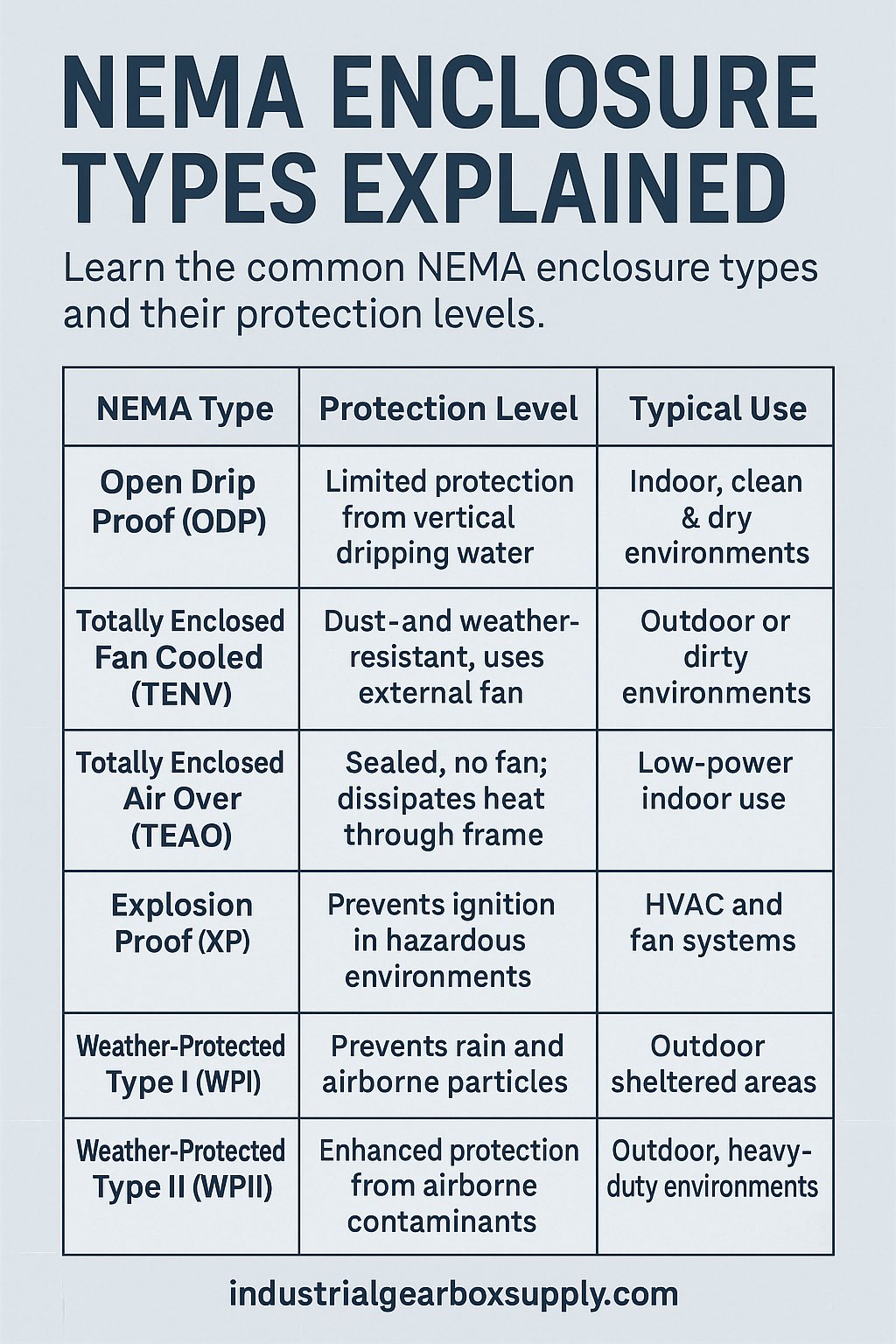
Below is a breakdown of the most frequently used NEMA motor enclosures and their characteristics:
| NEMA Type | Protection Level | Typical Use |
|---|---|---|
| Open Drip Proof (ODP) | Limited protection from vertical dripping water | Indoor, clean & dry environments |
| Totally Enclosed Fan Cooled (TEFC) | Dust- and weather-resistant, uses external fan | Outdoor or dirty environments |
| Totally Enclosed Non-Ventilated (TENV) | Sealed, no fan; dissipates heat through frame | Low-power indoor use |
| Totally Enclosed Air Over (TEAO) | Needs external airflow (e.g., fan or blower) | HVAC and fan systems |
| Explosion Proof (XP) | Prevents ignition in hazardous environments | Petrochemical, mining, grain handling |
| Weather-Protected Type I (WPI) | Prevents rain and airborne particles | Outdoor sheltered areas |
| Weather-Protected Type II (WPII) | Enhanced protection from airborne contaminants | Outdoor, heavy-duty environments |
Key Factors When Choosing an Enclosure
Environment: Is it dusty, wet, corrosive, or clean?
Application: Will the motor run indoors, outdoors, or in a hazardous zone?
Cooling Needs: Does it require an external fan or air-over system?
Maintenance: Open motors are easier to service but require cleaner surroundings.
Recommended: Use our FREE NEMA Frame Size Finder Tool to find the right enclosure for your motor.
TEFC vs ODP: A Quick Recap
If you're unsure whether to use a TEFC or ODP motor, here's a side-by-side refresher:
| Feature | TEFC | ODP |
|---|---|---|
| Enclosure | Totally enclosed, fan cooled | Open, drip-proof |
| Cooling Method | External fan | Airflow through motor |
| Ideal Use | Outdoor, dusty, moist | Indoor, clean, dry |
| Cost | Higher | Lower |
Why ABB NEMA Motors Meet All Enclosure Needs
ABB manufactures NEMA-rated motors in a full range of enclosure types, from ODP to Explosion Proof. Their motors are tested to meet the most demanding industrial and commercial specifications, offering long-term reliability, energy efficiency, and ease of maintenance.
Order NEMA Motors from Industrial Gearbox Supply
Not sure which NEMA enclosure you need? Our team at Industrial Gearbox Supply can help you find the right fit—fast. Whether you're outfitting an HVAC system, upgrading an industrial line, or replacing a motor in a hazardous zone, we’ve got you covered with ABB's full range of enclosure types.
Contact us today:
Phone: (517) 858-2966
Email: sales@industrialgearboxsupply.com
Website: industrialgearboxsupply.com
Location: 3590 Scheele Dr, Jackson, MI 49202