

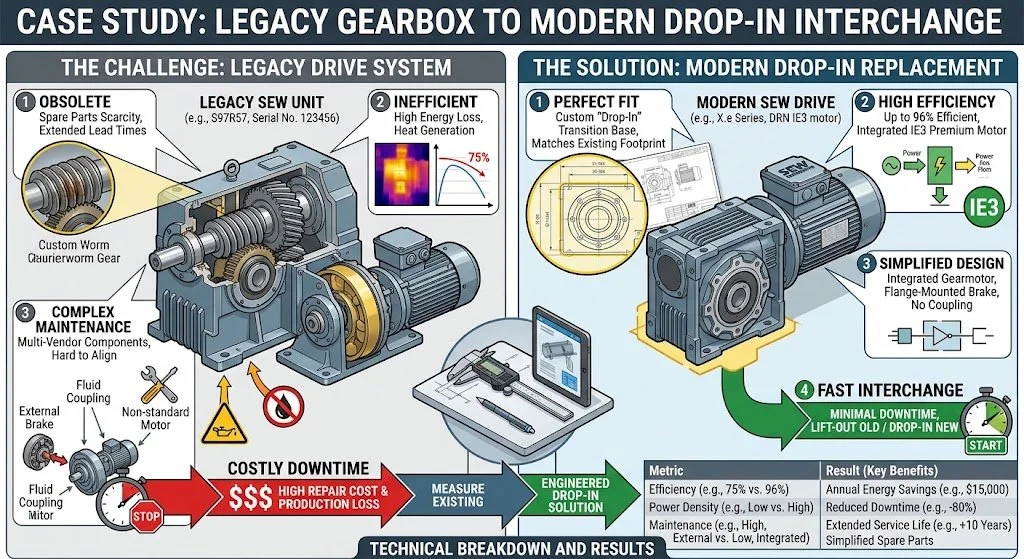
From Legacy Gearbox to Modern Replacement: A Drop-In Interchange Case Study
Follow an illustrative legacy gearbox replacement case study covering dimensional checks, performance ratings, adapter plates and coupling changes.

When a Gearbox Interchange Requires an Adapter Plate—and When It Doesn't
Evaluate when an engineered adapter plate can resolve gearbox mounting differences, and when shaft alignment or structural constraints require another approach.

What Makes Two Industrial Gearboxes Truly Interchangeable?
Learn which performance, dimensional, shaft, mounting, lubrication and application requirements determine whether two industrial gearboxes can interchange.

Center Height, Bolt Pattern and Shaft Diameter: How to Measure a Gearbox for Replacement
Learn to document shaft center height, bolt patterns, shaft diameter, keyways and other dimensions needed for gearbox replacement.

Gearbox Replacement Dimensions: The Measurements That Determine Whether a Reducer Will Fit
Compare gearbox mounting footprint, center height, shafts, flanges and overall envelope to determine whether a replacement reducer will fit.

What Does “Drop-In Gearbox Replacement” Actually Mean?
Understand the difference between functional equivalents and true drop-in gearbox replacements, including performance and dimensional verification.

How to Identify an Unknown Gearbox
Identify an unknown gearbox using nameplate information, housing shape, shaft dimensions, mounting, ratio and application details.

What Information You Need Before Ordering a Gearbox
Gather key application and installation information before ordering an industrial gearbox, including speed, torque, mounting and operating conditions.

Input Shaft vs Output Shaft: Design Differences
Understand the different roles of input and output shafts in industrial gearboxes, including speed, torque, dimensions and connected components.