

Worm Gearbox Efficiency vs Helical Efficiency
Efficiency is a critical factor when selecting an industrial gearbox. Two of the most commonly compared designs are worm gearboxes and helical gearboxes. While both are widely used, their efficiency characteristics are very different and can significantly impact energy consumption, heat generation, and long-term operating cost.
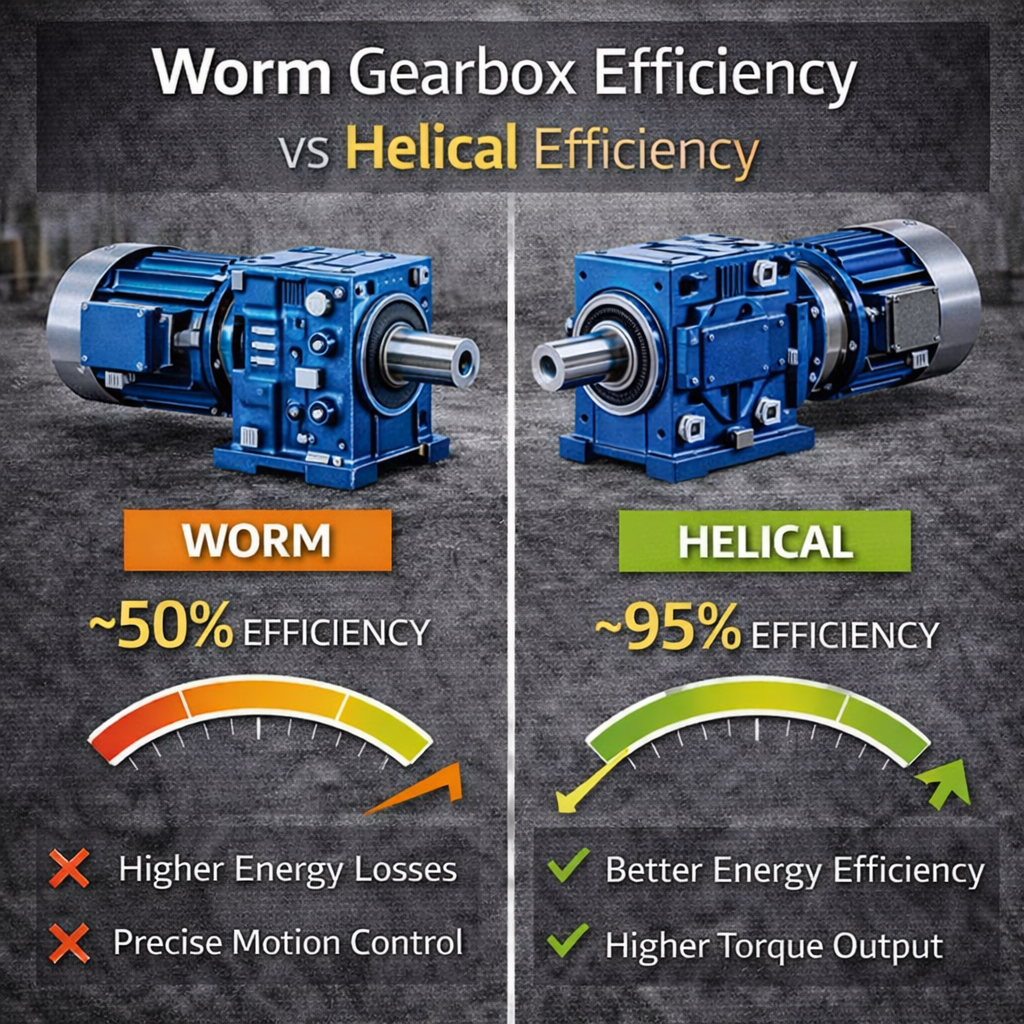
This article compares worm gearbox efficiency and helical gearbox efficiency to help you choose the right solution for your application.
How Gearbox Efficiency Is Defined
Gearbox efficiency refers to how much input power is delivered as usable output power.
Efficiency losses occur due to:
Gear tooth friction
Sliding versus rolling contact
Bearing losses
Lubrication shear
Heat generation
Higher efficiency means less energy lost as heat and lower operating costs.
Worm Gearbox Efficiency Explained
Worm gearboxes use a worm (screw) that drives a worm wheel. Power transfer occurs primarily through sliding contact rather than rolling contact.
Typical Worm Gearbox Efficiency
Worm gearbox efficiency typically ranges from:
50% to 90%, depending on ratio and design
Lower ratios may approach higher efficiency, while higher reduction ratios result in significantly lower efficiency.
Why Worm Gearboxes Are Less Efficient
Efficiency losses in worm gearboxes are caused by:
High sliding friction between worm and wheel
Increased heat generation
Lubricant shear losses
As ratio increases, sliding contact increases, further reducing efficiency.
Advantages Despite Lower Efficiency
Despite lower efficiency, worm gearboxes offer unique benefits:
Compact right-angle design
Smooth, quiet operation
Shock absorption
Self-locking characteristics in some ratios
These advantages make worm gearboxes suitable for specific applications despite efficiency limitations.
Helical Gearbox Efficiency Explained
Helical gearboxes use angled gear teeth that mesh gradually, allowing rolling contact between gear surfaces.
Typical Helical Gearbox Efficiency
Helical gearbox efficiency typically ranges from:
94% to 98% per gear stage
Multi-stage helical gearboxes maintain high overall efficiency even at higher reduction ratios.
Why Helical Gearboxes Are More Efficient
Helical gearboxes achieve higher efficiency because:
Power transfer occurs through rolling contact
Reduced friction between gear teeth
Lower heat generation
More efficient lubrication behavior
This makes helical gearboxes ideal for continuous-duty applications.
Efficiency Comparison by Application
Continuous-Duty Applications
Helical gearboxes are far superior in continuous-duty applications due to lower energy losses and reduced heat buildup.
Worm gearboxes may overheat or suffer accelerated wear under continuous operation.
Intermittent or Low-Duty Applications
Worm gearboxes can perform well in intermittent-duty applications where efficiency losses are less critical.
Infrequent operation allows heat to dissipate between cycles.
High Reduction Ratios
For high reduction ratios:
Worm gearboxes offer compact solutions but lower efficiency
Helical gearboxes require multiple stages but maintain higher efficiency
Energy costs over time often favor helical designs.
Heat Generation and Thermal Limits
Efficiency losses translate directly into heat.
Worm gearboxes:
Generate significantly more heat
Require careful thermal management
May need oversized housings or external cooling
Helical gearboxes:
Operate cooler
Handle higher continuous loads
Offer longer lubricant and component life
Heat is a major factor in gearbox reliability.
Energy Cost Considerations
Lower efficiency leads to higher energy consumption.
Over time:
Worm gearboxes can significantly increase operating costs
Helical gearboxes reduce energy use and heat-related failures
In energy-intensive operations, efficiency differences can outweigh initial cost savings.
Load and Shock Handling
Helical gearboxes handle shock loads better due to rolling contact and robust gear geometry.
Worm gearboxes:
Absorb shock well at low speeds
Can suffer accelerated wear under repeated heavy loads
Application severity should guide selection.
Maintenance and Service Life Impact
Efficiency affects service life.
Worm gearboxes:
Require more frequent oil changes
Are more sensitive to lubrication quality
Experience faster wear under continuous load
Helical gearboxes:
Offer longer service intervals
Provide more consistent performance over time
Maintenance costs often favor helical designs.
When a Worm Gearbox Makes Sense
A worm gearbox may be the right choice when:
Compact right-angle layout is required
Low speed operation is acceptable
Self-locking is beneficial
Duty cycle is light or intermittent
Efficiency is not the primary concern
When a Helical Gearbox Is the Better Choice
A helical gearbox is usually the better choice when:
High efficiency is required
Continuous-duty operation is expected
Energy costs matter
Long service life is critical
Heat generation must be minimized
Final Thoughts
Worm and helical gearboxes serve different purposes.
Worm gearboxes offer compact, quiet, right-angle solutions at the cost of efficiency, while helical gearboxes deliver superior efficiency, lower heat, and longer service life.
Understanding efficiency differences helps you choose the gearbox that delivers the best performance, reliability, and total cost of ownership for your application.
If you need help comparing worm and helical gearbox efficiency for your specific application, IndustrialGearboxSupply.com can help evaluate your requirements and recommend the right solution.