

Foot-Mounted vs Flange-Mounted Gearboxes
Mounting style is one of the most overlooked factors when selecting an industrial gearbox, yet it has a major impact on alignment, load distribution, reliability, and service life. Two of the most common mounting styles are foot-mounted and flange-mounted gearboxes.
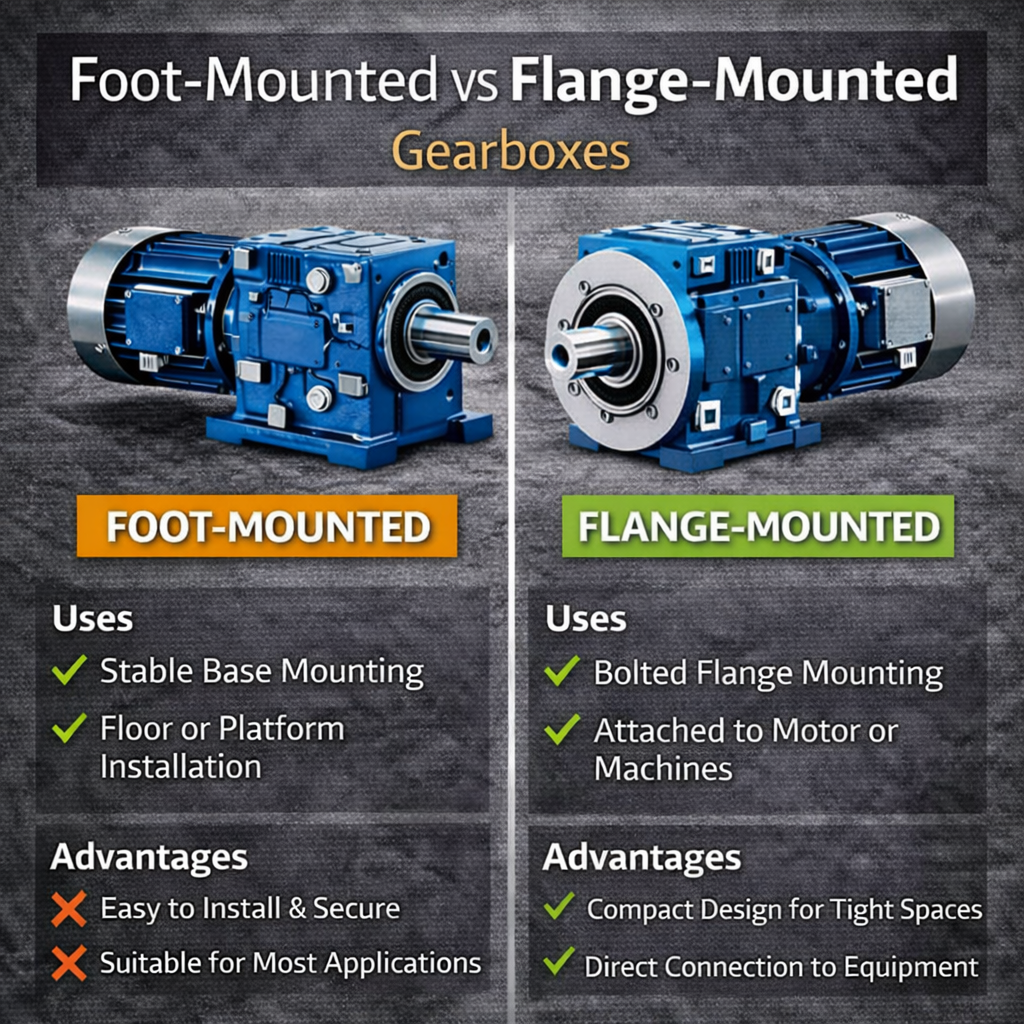
This article explains the differences between foot-mounted and flange-mounted gearboxes, along with the advantages, limitations, and best-use scenarios for each.
What Is a Foot-Mounted Gearbox?
A foot-mounted gearbox is supported by feet or a base that bolts directly to a flat surface such as a steel frame, baseplate, or concrete foundation. The gearbox is secured from underneath, allowing it to sit rigidly on a structural surface.
Foot-mounted designs are among the most common gearbox mounting styles in industrial environments.
What Is a Flange-Mounted Gearbox?
A flange-mounted gearbox is supported by a flange that bolts directly to the driven equipment or mounting face. Instead of resting on a base, the gearbox is suspended or supported by the flange connection.
Flange-mounted gearboxes are often used in compact machinery and applications where precise alignment with the driven shaft is critical.
Load Support and Structural Considerations
The way a gearbox is mounted determines how loads are transferred into the structure.
Foot-Mounted Gearbox Load Support
Foot-mounted gearboxes:
Distribute weight through the base
Rely on the mounting surface for support
Handle high gearbox weight and torque well
They are well suited for larger gearboxes and high-torque applications.
Flange-Mounted Gearbox Load Support
Flange-mounted gearboxes:
Transfer load through the flange and fasteners
Require a rigid mounting face
Place more stress on the driven equipment structure
Improper flange support can lead to alignment issues and premature bearing wear.
Alignment and Installation
Alignment requirements differ between the two mounting styles.
Foot-Mounted Gearbox Alignment
Foot-mounted gearboxes:
Require careful shaft alignment
Allow adjustment during installation
Can be shimmed to achieve proper alignment
They are ideal where alignment flexibility is needed.
Flange-Mounted Gearbox Alignment
Flange-mounted gearboxes:
Provide fixed alignment once bolted
Rely on precision machining of the mounting face
Offer excellent concentricity when installed correctly
They are commonly used in direct-drive applications.
Space and Layout Considerations
Mounting style often affects machine layout.
Foot-mounted gearboxes:
Require space for base and feet
May increase overall equipment footprint
Flange-mounted gearboxes:
Offer compact, space-saving designs
Reduce overall machine size
Are ideal for tight installations
Space constraints often drive flange-mounted gearbox selection.
Torque and Overhung Load Considerations
External loads must be considered when selecting a mounting style.
Foot-mounted gearboxes:
Better handle high torque and overhung loads
Are more forgiving under belt or chain drives
Flange-mounted gearboxes:
Must be carefully evaluated for overhung loads
Can experience flange stress if external loads are excessive
Ignoring these factors can lead to premature failure.
Maintenance and Serviceability
Mounting style impacts ease of maintenance.
Foot-mounted gearboxes:
Are easier to access
Simplify removal and replacement
Allow servicing without disturbing driven equipment
Flange-mounted gearboxes:
May require removal of connected equipment
Can complicate service in confined spaces
Maintenance planning is critical when choosing mounting style.
Vibration and Stability
Mounting rigidity affects vibration levels.
Foot-mounted gearboxes:
Provide excellent stability when mounted to rigid bases
Reduce vibration transmission
Flange-mounted gearboxes:
Depend on the stiffness of the mounting structure
May transmit vibration into driven equipment
Vibration control should be considered for sensitive machinery.
Cost and Standardization
Cost differences depend on size and application.
Foot-mounted gearboxes:
Often more economical for larger sizes
Are widely standardized
Offer broad availability
Flange-mounted gearboxes:
May cost more due to precision requirements
Are common in OEM equipment designs
Total system cost should guide the decision.
Common Applications for Each Mounting Style
Foot-mounted gearboxes are commonly used in:
Conveyors
Mixers and agitators
Heavy-duty industrial machinery
Material handling systems
Flange-mounted gearboxes are commonly used in:
Packaging equipment
Automation systems
Direct-drive machinery
Compact OEM equipment
Which Mounting Style Should You Choose?
A foot-mounted gearbox is usually the better choice when:
High torque is required
Equipment weight is significant
Overhung loads are present
Ease of maintenance is important
A flange-mounted gearbox is usually the better choice when:
Space is limited
Precise alignment is critical
Direct mounting to equipment is preferred
Compact design is required
The correct choice depends on application demands, not convenience.
Final Thoughts
Foot-mounted and flange-mounted gearboxes both play important roles in industrial power transmission.
Foot-mounted designs offer durability, load-handling capability, and ease of maintenance, while flange-mounted designs provide compactness and precise alignment in space-constrained systems.
Understanding these differences helps ensure reliable operation, longer service life, and reduced downtime.
If you need help selecting the correct gearbox mounting style, IndustrialGearboxSupply.com can help evaluate your application and recommend the best solution.