

Planetary vs Helical Gearboxes: Precision vs Durability
Choosing between a planetary gearbox and a helical gearbox often comes down to a trade-off between precision and durability. Both designs are widely used in industrial applications, but they excel in different areas. Selecting the wrong type can lead to unnecessary wear, control issues, or higher operating costs.
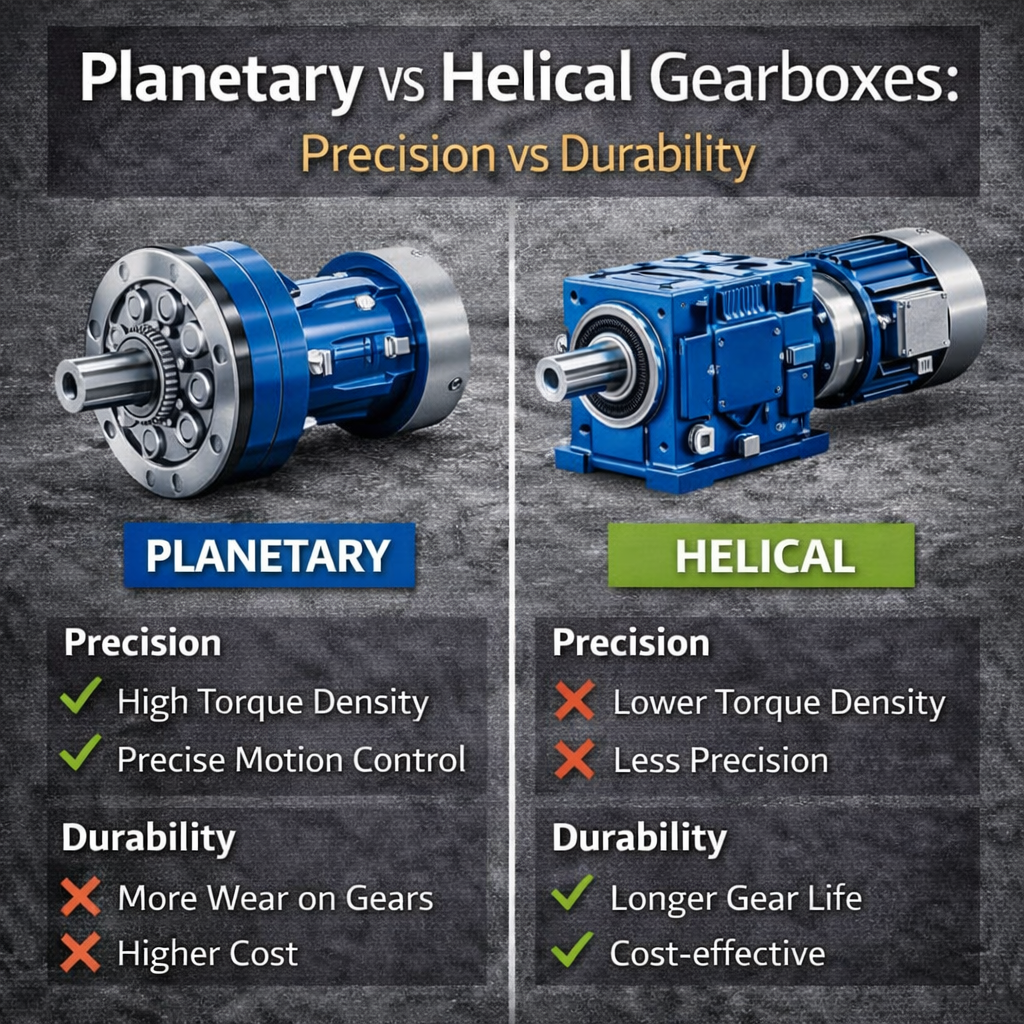
This article compares planetary and helical gearboxes, explaining where each design performs best and how to choose the right option for your application.
What Is a Planetary Gearbox?
A planetary gearbox consists of a central sun gear, multiple planet gears, and an outer ring gear. Power is transmitted through several gears simultaneously, distributing load evenly across the system.
Planetary gearboxes are known for:
High torque density
Compact size
Low backlash options
High positioning accuracy
They are commonly used in precision-driven and space-constrained applications.
What Is a Helical Gearbox?
A helical gearbox uses angled (helical) gear teeth that mesh gradually, providing smooth and quiet power transmission. Power typically flows through a series of parallel shafts.
Helical gearboxes are known for:
Robust construction
High efficiency
Excellent durability
Long service life
They are widely used in continuous-duty and heavy industrial applications.
Precision and Backlash Comparison
Precision is one of the most significant differences between planetary and helical gearboxes.
Planetary Gearbox Precision
Planetary gearboxes are often designed with very low backlash.
Advantages include:
High positioning accuracy
Minimal lost motion
Excellent repeatability
Strong torsional stiffness
These characteristics make planetary gearboxes ideal for servo-driven systems, robotics, and automation.
Helical Gearbox Precision
Standard helical gearboxes typically have higher backlash than planetary designs.
While acceptable for most industrial machinery, higher backlash can:
Reduce positioning accuracy
Affect motion control systems
Limit use in precision applications
Low-backlash helical gearboxes are available but are less common and often more expensive.
Durability and Load Handling
Durability is where helical gearboxes often excel.
Helical Gearbox Durability
Helical gearboxes are designed for:
Continuous-duty operation
Heavy loads
Long service life
Harsh industrial environments
Their robust housings, large bearings, and straightforward gear trains make them highly durable and forgiving under real-world conditions.
Planetary Gearbox Durability
Planetary gearboxes handle high torque well due to load sharing, but durability depends heavily on:
Manufacturing quality
Application severity
Maintenance practices
In shock-load or heavily contaminated environments, planetary gearboxes may be more sensitive than helical designs.
Torque Density and Size
Torque density refers to how much torque a gearbox can transmit relative to its size.
Planetary Gearboxes
Planetary gearboxes offer very high torque density.
Benefits include:
Compact footprint
Reduced machine size
High torque in limited space
This makes them ideal for applications where space is limited.
Helical Gearboxes
Helical gearboxes typically require more space to achieve the same torque rating.
However, the larger size often contributes to increased durability and thermal capacity.
Efficiency and Heat Generation
Both designs are generally efficient, but performance varies by application.
Planetary gearboxes:
Offer high efficiency
Perform well across wide speed ranges
Are commonly used with servo motors and VFDs
Helical gearboxes:
Provide excellent efficiency in continuous-duty operation
Dissipate heat well due to larger housings
Are less sensitive to minor overloads
Heat management often favors helical gearboxes in high-duty industrial environments.
Maintenance and Service Life
Maintenance requirements differ between the two designs.
Helical Gearbox Maintenance
Helical gearboxes are generally:
Easier to service
More tolerant of contamination
Capable of longer service intervals
They are often preferred where maintenance access is limited.
Planetary Gearbox Maintenance
Planetary gearboxes:
Require clean lubrication
Are more sensitive to contamination
Often have more complex internal components
Proper lubrication and monitoring are critical to achieving long service life.
Cost Considerations
Cost depends on size, quality, and application.
Planetary gearboxes:
Often cost more upfront
Justify cost through precision and compactness
Helical gearboxes:
Typically lower cost for comparable torque
Offer strong value for heavy-duty applications
Total cost of ownership should be considered, not just purchase price.
Typical Applications for Each Gearbox Type
Planetary gearboxes are commonly used in:
Robotics
Automation systems
Servo-driven machinery
Packaging equipment
Precision positioning systems
Helical gearboxes are commonly used in:
Conveyors
Mixers and agitators
Fans and pumps
Heavy material handling
Continuous-duty industrial equipment
Which Gearbox Should You Choose?
A planetary gearbox is usually the better choice when:
High precision is required
Low backlash is critical
Space is limited
Servo or motion control is involved
A helical gearbox is usually the better choice when:
Durability and longevity are priorities
Continuous-duty operation is expected
Shock loading may occur
Maintenance simplicity is important
The correct choice depends on balancing precision requirements against durability needs.
Final Thoughts
Planetary and helical gearboxes both serve critical roles in industrial power transmission.
Planetary gearboxes excel in precision, compactness, and motion control, while helical gearboxes deliver durability, simplicity, and long-term reliability.
Understanding the trade-offs between these designs ensures you select the gearbox that best fits your application’s performance, environment, and lifecycle requirements.
If you need help choosing between a planetary or helical gearbox, IndustrialGearboxSupply.com can help evaluate your application and recommend the right solution.