

Common Gearbox Ordering Mistakes
Ordering the wrong gearbox is one of the most expensive and avoidable mistakes in industrial power transmission. Many gearbox failures, installation delays, and performance problems originate not from poor equipment quality, but from incorrect or incomplete information provided during the ordering process.
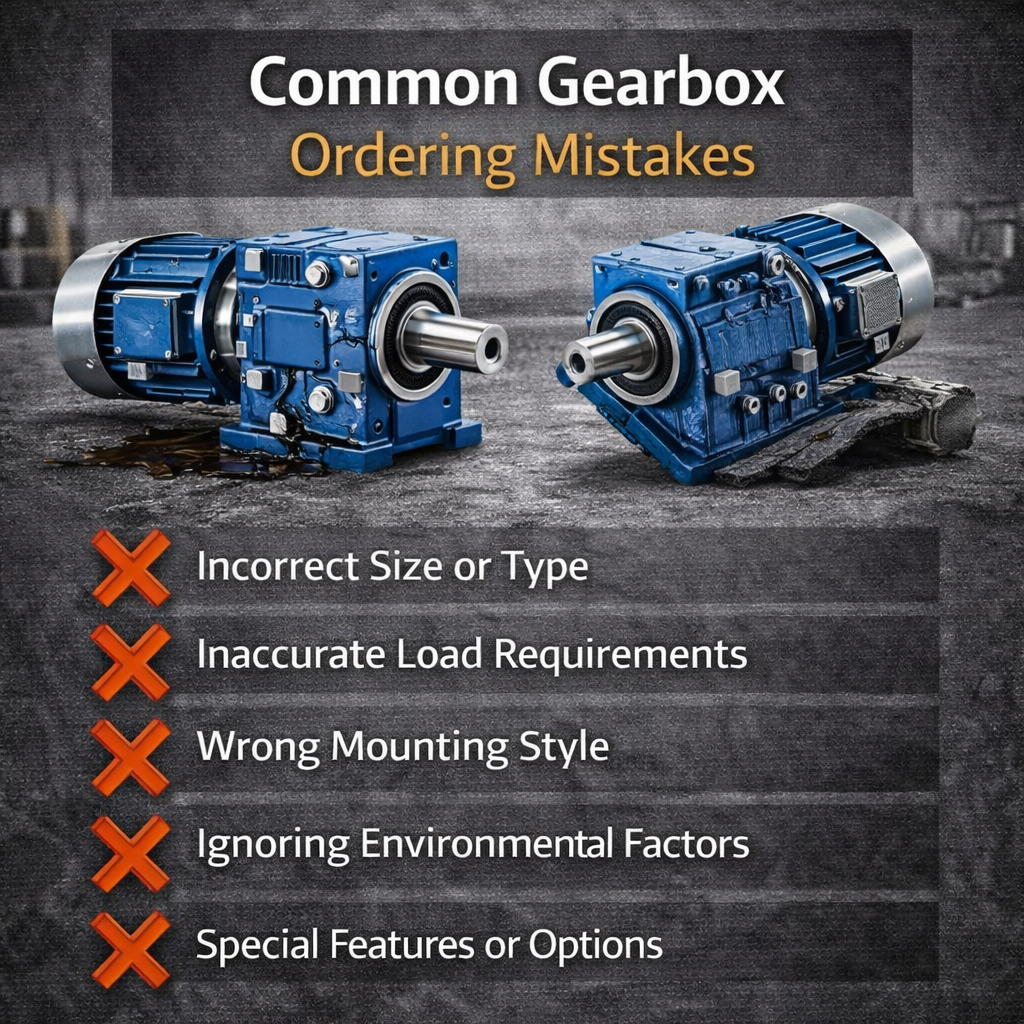
This article outlines the most common gearbox ordering mistakes and explains how to avoid them.
Why Gearbox Ordering Mistakes Are So Costly
Gearboxes are application-specific components. Small errors in sizing, mounting, or load assumptions can lead to:
Premature failure
Excessive downtime
Installation rework
Increased maintenance costs
Safety risks
Missed production deadlines
Most of these issues can be avoided with proper preparation and communication.
Ordering Based Only on Motor Horsepower
One of the most common mistakes is selecting a gearbox solely based on motor horsepower.
Motor horsepower does not account for:
Load torque
Starting conditions
Shock loading
Duty cycle
Overhung or axial loads
Gearboxes should always be sized based on actual load requirements, not just motor nameplate data.
Ignoring Starting and Peak Torque
Many applications require significantly higher torque during startup than during normal operation.
Failing to account for:
Starting torque
Acceleration torque
Jam or stall conditions
often results in undersized gearboxes that fail early.
Peak torque must be considered, especially in conveyors, mixers, crushers, and variable speed systems.
Underestimating Service Factor
Service factor accounts for application severity.
A common mistake is selecting the minimum allowable service factor without considering:
Shock loading
Frequent starts and stops
Reversing operation
Continuous duty
Underestimating service factor leads to gear tooth fatigue, bearing damage, and overheating.
Incorrect Gear Ratio Selection
Choosing the wrong gear ratio affects both performance and reliability.
Common ratio-related mistakes include:
Incorrect output speed calculation
Ignoring variable speed operation
Overspeeding or underspeeding equipment
Not accounting for speed range in VFD applications
Gear ratios must match the actual operating requirements, not just theoretical calculations.
Wrong Mounting Orientation
Gearboxes are designed for specific mounting positions.
Ordering a gearbox without confirming mounting orientation can lead to:
Improper lubrication
Bearing starvation
Seal failure
Reduced service life
Always specify whether the gearbox will be mounted horizontally, vertically, or shaft-mounted.
Mismatched Shaft Dimensions
Incorrect shaft details frequently cause installation delays.
Common shaft-related mistakes include:
Wrong shaft diameter
Incorrect keyway size
Wrong shaft length
Assuming standard dimensions without verification
Providing exact shaft specifications prevents costly rework.
Ignoring Overhung and Axial Loads
External loads applied by belts, chains, or sprockets are often overlooked.
Ignoring overhung or axial loads leads to:
Bearing failure
Shaft deflection
Seal damage
Increased vibration
These loads must be calculated and communicated during gearbox selection.
Failing to Consider the Operating Environment
Environmental conditions significantly impact gearbox performance.
Common oversights include:
Washdown or moisture exposure
Dust or abrasive contamination
High or low ambient temperatures
Corrosive chemicals
Outdoor operation
Gearboxes must be designed to survive their environment.
Overlooking Lubrication Requirements
Lubrication is often treated as an afterthought.
Mistakes include:
Incorrect oil viscosity
Ignoring food-grade lubricant requirements
Not accounting for temperature extremes
Extending oil change intervals beyond recommendations
Incorrect lubrication accelerates wear and shortens gearbox life.
Not Accounting for Noise or Precision Requirements
Some applications require low noise or precise positioning.
Failing to specify:
Noise limits
Backlash requirements
Positioning accuracy
can result in gearboxes that technically function but fail to meet application expectations.
Ordering Without Space and Clearance Considerations
Physical constraints are often overlooked.
Mistakes include:
Not verifying available installation space
Ignoring maintenance access
Overlooking weight limitations
Assuming a replacement will be a direct drop-in
Dimensional verification prevents installation surprises.
Assuming All Rebuilds or Replacements Are Equivalent
When replacing an existing gearbox, many assume a like-for-like replacement will solve the problem.
If the original gearbox was undersized or misapplied, replacing it with the same model will repeat the failure.
Ordering is an opportunity to correct design issues.
Failing to Communicate Lead Time Constraints
Not communicating lead time expectations can limit available options.
In urgent situations, alternative models or configurations may be available if lead time requirements are clearly stated.
How to Avoid Gearbox Ordering Mistakes
Most ordering mistakes are preventable.
Best practices include:
Calculating load torque accurately
Accounting for peak and shock loads
Applying appropriate service factors
Confirming mounting orientation and shaft details
Communicating environmental conditions
Reviewing space constraints
Discussing lead time upfront
Working with experienced gearbox suppliers reduces risk significantly.
Final Thoughts
Common gearbox ordering mistakes often stem from incomplete information rather than poor equipment quality.
Taking the time to gather accurate application details prevents undersizing, installation delays, and premature failure.
If you want to avoid costly gearbox ordering mistakes, IndustrialGearboxSupply.com can help review your application and ensure the correct gearbox is selected the first time.