

Gearboxes for Food & Beverage Applications
Food and beverage processing places some of the most demanding and specialized requirements on industrial gearboxes. In addition to mechanical performance, these applications require strict compliance with sanitation, safety, and regulatory standards. Selecting the wrong gearbox can lead to contamination risks, excessive downtime, and regulatory issues.
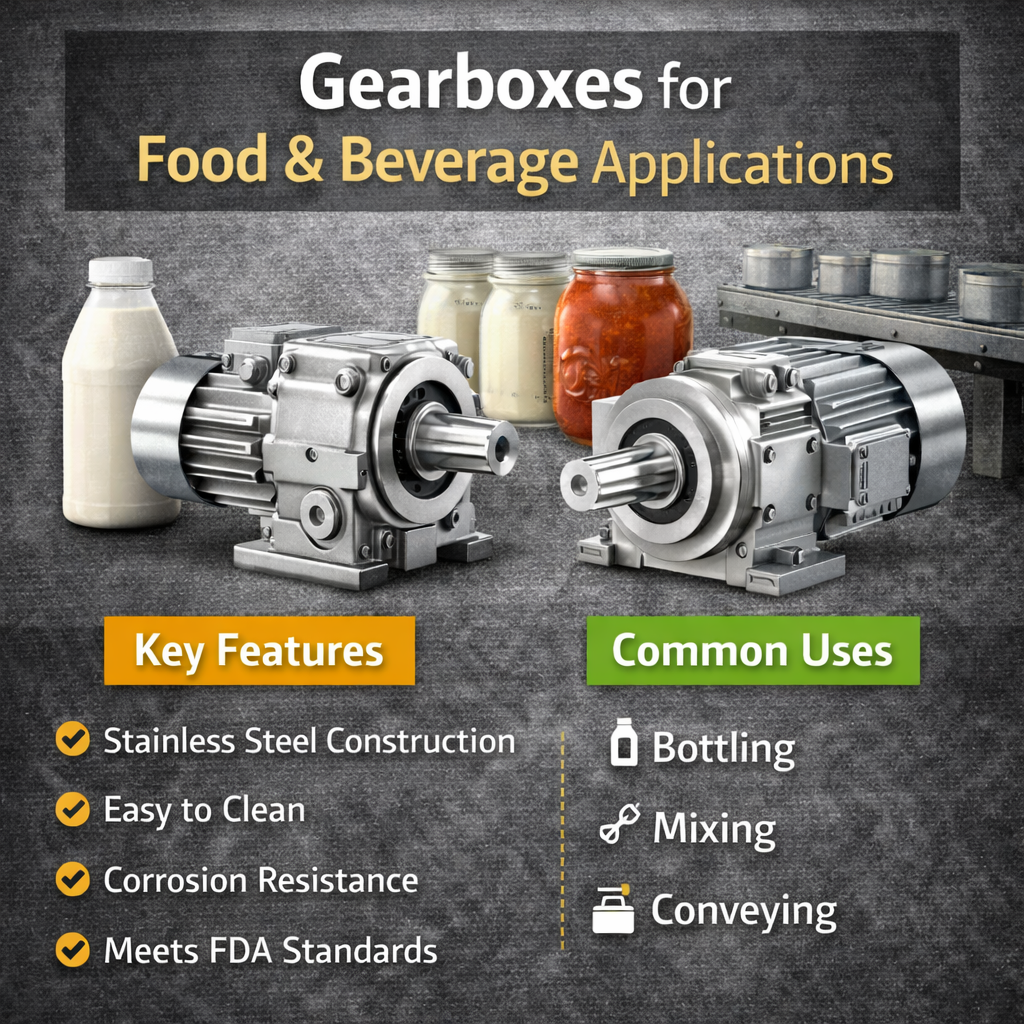
This article explains how to select gearboxes for food and beverage applications and highlights the most common failure modes seen in processing environments.
Why Food & Beverage Gearbox Selection Is Different
Unlike many industrial environments, food and beverage facilities require equipment that is both mechanically reliable and hygienic.
Key characteristics of food and beverage applications include:
Washdown environments
Strict sanitation requirements
Corrosive cleaning chemicals
Continuous or extended operation
Moderate to high torque demands
Compliance with food safety regulations
Gearboxes must be designed to withstand these conditions without compromising performance or safety.
Common Food & Beverage Applications Using Gearboxes
Gearboxes are used throughout food and beverage processing lines, including:
Conveyors and material handling systems
Mixers and agitators
Fillers, cappers, and packaging equipment
Bottling and canning lines
Grinders, slicers, and cutters
Each application presents different load, speed, and hygiene challenges.
Key Gearbox Selection Factors for Food & Beverage Applications
Selecting the right gearbox requires balancing mechanical performance with sanitary design.
Sanitary Design and Cleanability
Food-grade gearboxes are designed with smooth surfaces, minimal crevices, and rounded edges to prevent bacteria buildup.
Design features often include:
Smooth housings
Sealed fasteners
Sloped surfaces for drainage
Minimal exposed threads
These features make cleaning easier and more effective.
Housing Materials
Material selection is critical in washdown environments.
Common housing materials include:
Stainless steel for corrosive or high-sanitation areas
Aluminum with protective coatings for lighter washdown applications
Specialized food-grade coatings on cast iron housings
Material choice affects corrosion resistance, durability, and cost.
Lubrication Requirements
Food and beverage gearboxes often require food-grade lubricants.
Lubricants must:
Meet NSF H1 or H2 requirements
Maintain viscosity under washdown conditions
Provide adequate protection under load
Incorrect lubricant selection can lead to premature wear or contamination risks.
Sealing and Protection
Seals must prevent both lubricant leakage and ingress of water or cleaning chemicals.
High-quality seals and proper breather design are essential to maintain gearbox integrity.
Torque, Speed, and Duty Cycle
While many food processing applications involve moderate loads, others require high torque and continuous duty.
Gearboxes must be sized for:
Starting torque
Continuous operation
Shock loading from product flow or jams
Undersizing leads to overheating and premature failure.
Gearbox Types Commonly Used in Food & Beverage Applications
Several gearbox designs are well suited for sanitary environments.
Helical Gearboxes
Helical gearboxes are widely used for conveyors and auxiliary drives.
They provide:
High efficiency
Smooth operation
Reliable performance
Bevel and Helical-Bevel Gearboxes
Bevel gearboxes are used when right-angle power transmission is required.
They are common in compact layouts and overhead conveyor systems.
Planetary Gearboxes
Planetary gearboxes are used for high-torque applications in compact spaces.
They are often selected for mixers, agitators, and heavy-duty processing equipment.
Shaft-Mounted Gearboxes
Shaft-mounted designs are popular in conveyor applications due to their simplicity and ease of installation.
They must be carefully selected for washdown environments.
Common Gearbox Failures in Food & Beverage Processing
Food and beverage gearbox failures often stem from environmental exposure.
Corrosion
Exposure to moisture and cleaning chemicals causes corrosion of housings, shafts, and fasteners.
Corrosion weakens components and compromises seals.
Seal Failures
Frequent washdowns place stress on seals.
Seal failure leads to lubricant loss and contamination risks.
Lubrication Breakdown
Washdown conditions and temperature fluctuations degrade lubricants.
Improper lubricant selection accelerates wear and reduces gearbox life.
Bearing Failures
Contamination and corrosion often lead to bearing damage.
Bearing failures increase noise, vibration, and heat.
Thermal Overload
Continuous operation combined with poor heat dissipation leads to overheating.
Overheating accelerates lubricant breakdown and component wear.
Early Warning Signs of Gearbox Issues in Food & Beverage Applications
Food and beverage gearboxes often provide early warning signs before failure.
Common indicators include:
Oil leaks or lubricant discoloration
Increased noise or vibration
Rising operating temperature
Corrosion on housing or fasteners
Reduced processing efficiency
Early detection helps prevent downtime and contamination risks.
Preventing Gearbox Failures in Food & Beverage Facilities
Preventive measures significantly improve gearbox reliability.
Best practices include:
Selecting gearboxes designed for sanitary environments
Using approved food-grade lubricants
Maintaining seals and breathers
Performing routine inspections
Monitoring temperature and vibration
Training maintenance staff on sanitation procedures
Preventive maintenance reduces downtime and extends equipment life.
When to Upgrade or Replace a Food & Beverage Gearbox
A gearbox should be upgraded or replaced when:
Sanitation requirements change
Corrosion becomes persistent
Failures occur frequently
Throughput or torque requirements increase
Regulatory compliance is compromised
Replacing a non-sanitary gearbox with a purpose-built food-grade unit often improves reliability and compliance.
Final Thoughts
Food and beverage applications require gearboxes that combine mechanical reliability with strict sanitary design.
Most gearbox failures in these environments result from corrosion, seal failure, or improper lubrication.
Understanding application requirements and selecting the right gearbox helps ensure safe, reliable, and compliant operation.
If you need help selecting or troubleshooting a gearbox for food and beverage applications, IndustrialGearboxSupply.com can help guide you toward the right solution.