

Gearboxes for Packaging Equipment
Packaging equipment places unique and often underestimated demands on gearboxes. Unlike heavy-duty bulk handling applications, packaging machinery requires precision, repeatability, and reliability at high cycle rates. Incorrect gearbox selection can lead to inconsistent performance, excessive wear, and costly downtime.
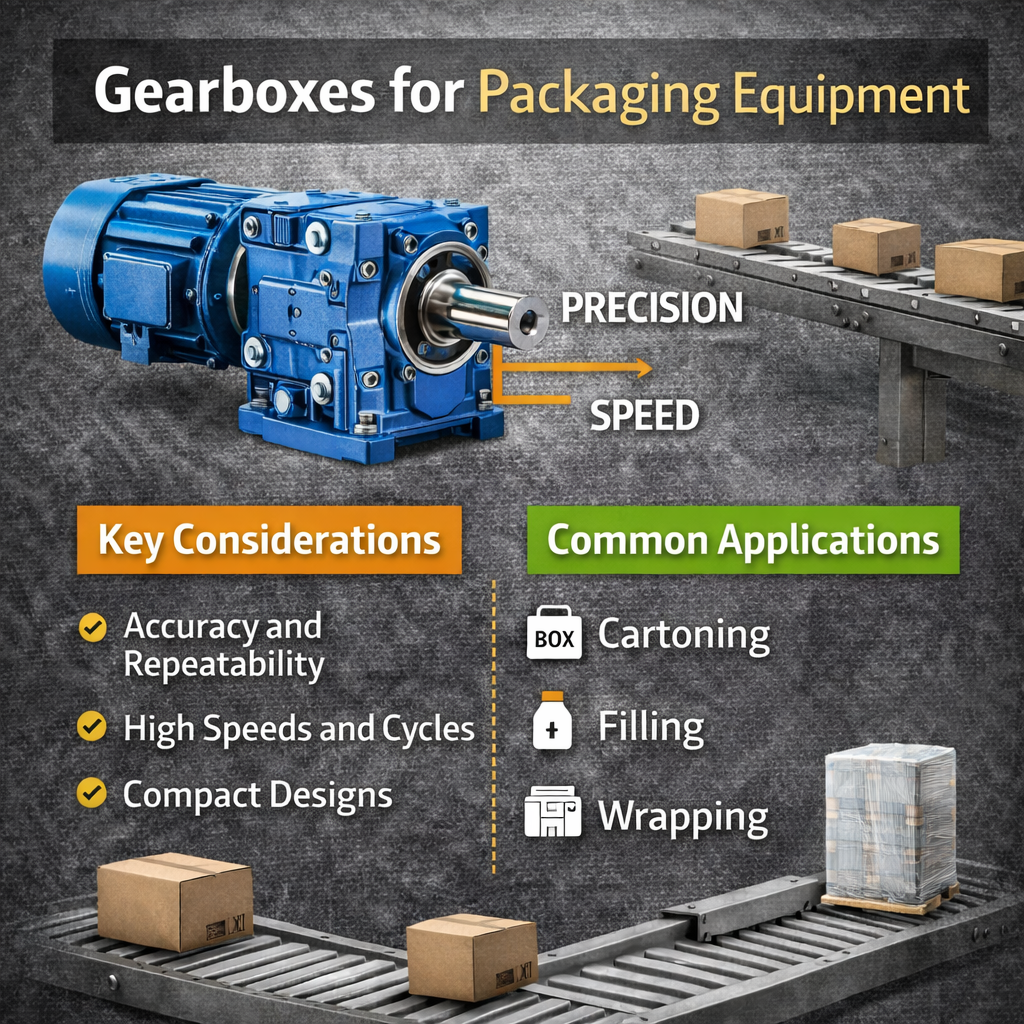
This article explains how to select gearboxes for packaging equipment and highlights common failure modes seen in real-world packaging applications.
Why Packaging Equipment Requires Specialized Gearbox Selection
Packaging machines operate in fast-paced, repetitive environments where accuracy and uptime are critical.
Common characteristics of packaging equipment include:
High cycle rates
Frequent starts and stops
Precise positioning requirements
Light to moderate loads
Continuous or near-continuous operation
Gearboxes used in packaging equipment must balance speed, torque, efficiency, and precision.
Common Types of Packaging Equipment
Packaging applications vary widely, but common equipment includes:
Conveyors and indexing systems
Cartoners and case packers
Fillers and cappers
Wrappers and labelers
Pick-and-place systems
Each type places different demands on gearbox speed, torque, and backlash.
Key Gearbox Selection Factors for Packaging Equipment
Proper gearbox selection starts with understanding application-specific requirements.
Output Speed and Accuracy
Packaging machines often require precise output speeds to maintain consistent throughput.
Small speed variations can cause:
Product misalignment
Inconsistent fill levels
Timing issues between machine stations
Gearbox ratios must be selected carefully to maintain consistent motion.
Backlash and Positioning Precision
Many packaging machines rely on accurate positioning.
Excessive backlash leads to:
Lost motion
Inaccurate indexing
Poor repeatability
Low-backlash gearboxes are often preferred for indexing, pick-and-place, and servo-driven packaging systems.
Frequent Starts and Stops
Packaging equipment cycles frequently.
Repeated acceleration and deceleration place stress on gears, bearings, and shafts. Gearboxes must be rated for high cyclic duty and adequate service factor.
Torque Requirements
While packaging loads are often lighter than bulk handling applications, starting torque can still be significant due to inertia.
Torque calculations must account for:
Load inertia
Acceleration rates
Emergency stops
Jam conditions
Undersized gearboxes fail quickly under repeated shock loading.
Efficiency and Heat Management
High-speed operation generates heat.
Efficient gearboxes reduce heat buildup, protect lubricant life, and improve energy efficiency. Heat buildup is especially problematic in enclosed packaging equipment.
Compact Design and Space Constraints
Packaging machines often have limited space.
Compact gearbox designs such as planetary gearboxes are frequently used to meet space and performance requirements.
Common Gearbox Types Used in Packaging Equipment
Several gearbox designs are well suited for packaging applications.
Planetary Gearboxes
Planetary gearboxes are widely used due to their:
High torque density
Compact size
Low backlash options
High efficiency
They are ideal for servo-driven and precision packaging systems.
Helical Gearboxes
Helical gearboxes provide smooth operation and good efficiency.
They are commonly used in conveyors and auxiliary drives within packaging lines.
Bevel and Helical-Bevel Gearboxes
Bevel gearboxes are used when right-angle power transmission is required.
They are often found in space-constrained packaging machinery.
Servo Gearboxes
Servo-specific gearboxes are designed for high accuracy and rapid response.
They are commonly paired with servo motors in modern packaging systems.
Common Gearbox Failures in Packaging Equipment
Packaging gearbox failures often result from predictable issues.
Excessive Backlash
Backlash increases over time due to wear.
In precision applications, even small increases in backlash lead to performance problems and scrap.
Bearing Wear
High cycle rates and frequent starts accelerate bearing fatigue.
Bearing wear often manifests as increased noise, vibration, or positioning errors.
Overheating
High-speed operation and compact enclosures limit heat dissipation.
Overheating degrades lubricant and shortens gearbox life.
Lubrication Problems
Incorrect lubricant selection or extended service intervals reduce efficiency and increase wear.
Food-grade lubricants may be required in some packaging environments, which further emphasizes proper selection.
Misalignment
Misalignment between motors, gearboxes, and driven components causes vibration and accelerates wear.
Precision packaging machines are especially sensitive to alignment errors.
Early Warning Signs of Gearbox Issues in Packaging Equipment
Packaging gearboxes often provide early warning signs before failure.
Common indicators include:
Increased noise or vibration
Reduced positioning accuracy
Rising operating temperature
Oil leaks
Increased motor current draw
Monitoring these signs helps prevent unexpected downtime.
Preventing Gearbox Failures in Packaging Applications
Reliability improves significantly with proper selection and maintenance.
Best practices include:
Selecting low-backlash gearboxes where precision is required
Applying appropriate service factors for cyclic duty
Ensuring proper alignment
Using correct lubricant type and viscosity
Monitoring temperature and vibration
Performing routine inspections
Preventive maintenance is essential in high-speed packaging environments.
When to Upgrade or Replace a Packaging Gearbox
A gearbox should be upgraded or replaced when:
Throughput requirements increase
Precision requirements tighten
Failures become frequent
Efficiency losses increase energy costs
Backlash affects product quality
Replacing an undersized or worn gearbox often improves performance immediately.
Final Thoughts
Packaging equipment places unique demands on gearboxes, requiring a balance of speed, precision, efficiency, and durability.
Most gearbox failures in packaging applications are caused by excessive backlash, undersizing, bearing wear, or overheating.
Understanding application requirements and selecting the right gearbox helps ensure reliable operation and consistent product quality.
If you need help selecting or troubleshooting a gearbox for packaging equipment, IndustrialGearboxSupply.com can help guide you toward the right solution.