

Gearboxes for Variable Speed Applications
Variable speed applications place unique demands on industrial gearboxes. Unlike fixed-speed systems, variable speed operation exposes gearboxes to changing torque, fluctuating loads, frequent acceleration and deceleration, and wide operating speed ranges. Selecting a gearbox without accounting for these conditions often leads to overheating, excessive wear, and shortened service life.
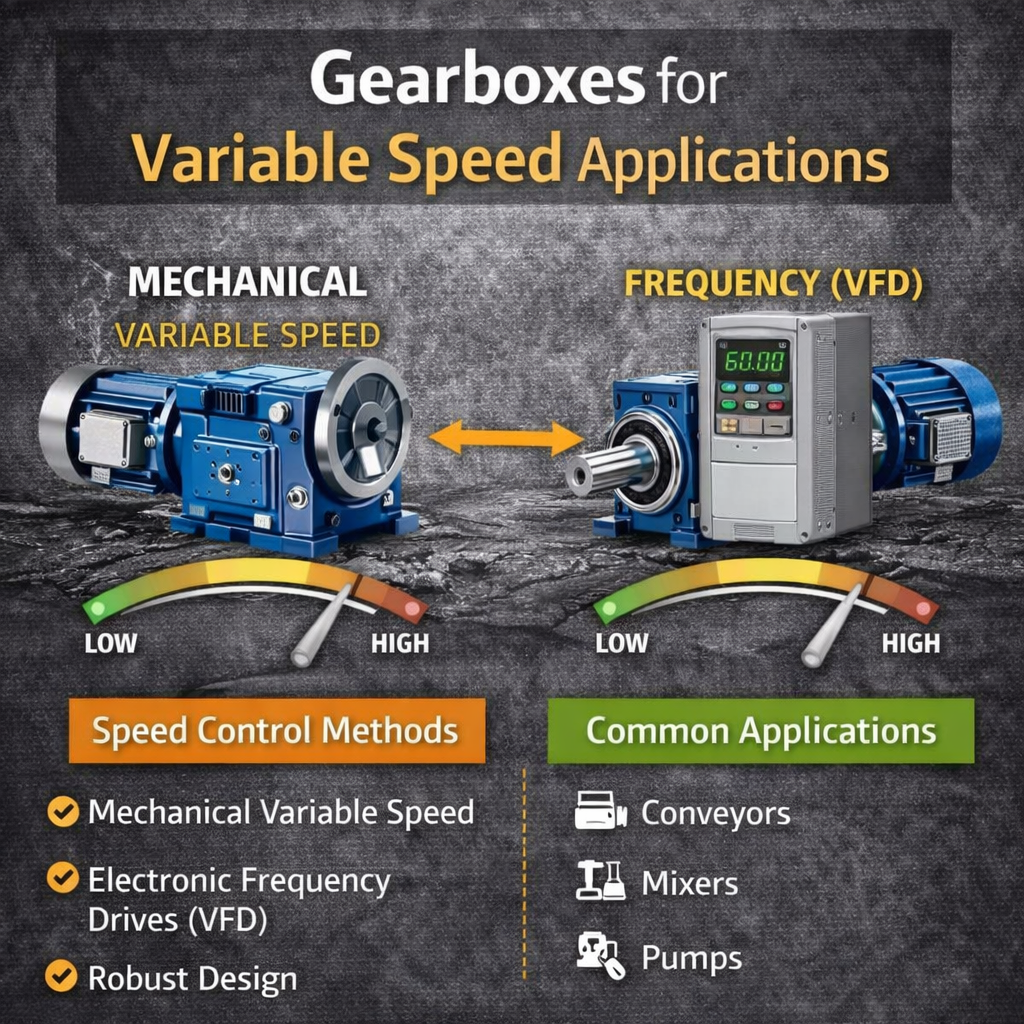
This article explains how to select gearboxes for variable speed applications and highlights common failure modes seen in systems that rely on speed variation.
What Is a Variable Speed Application?
A variable speed application is any system where operating speed changes during normal operation rather than remaining constant.
Speed variation may be achieved through:
Variable Frequency Drives (VFDs)
Servo motors
Mechanical speed changers
Process-controlled automation systems
Common variable speed applications include conveyors, mixers, packaging equipment, machine tools, fans, pumps, and material handling systems.
Why Variable Speed Operation Is Hard on Gearboxes
Variable speed operation introduces stresses that are not present in steady-speed systems.
Key challenges include:
Increased torque at low speeds
Reduced cooling at low RPM
Frequent acceleration and deceleration
Torque ripple from electronic drives
Operation outside optimal efficiency ranges
Gearboxes must be selected to handle worst-case conditions, not just nominal operating points.
Key Gearbox Selection Factors for Variable Speed Applications
Proper gearbox selection requires evaluating the full operating range.
Torque Across the Speed Range
Torque demand often increases as speed decreases, especially in constant-torque applications.
Gearboxes must be rated for:
Peak torque at the lowest operating speed
Starting torque during acceleration
Torque spikes during rapid speed changes
Undersizing based on average torque leads to gear and bearing damage.
Thermal Capacity and Cooling
At low speeds, gearboxes generate heat but have reduced airflow for cooling.
Thermal capacity becomes a limiting factor, particularly in enclosed systems. Gearboxes may require:
Higher efficiency designs
Increased oil volume
External cooling or fans
Conservative service factors
Ignoring thermal limits leads to lubricant breakdown and overheating.
Duty Cycle and Speed Changes
Frequent speed changes increase mechanical stress.
Gearboxes must tolerate:
High cycle rates
Repeated acceleration and deceleration
Reversing operation
Duty cycle analysis is critical when speed changes occur continuously.
Gearbox Efficiency
Efficiency varies across speed and load ranges.
High-efficiency gearbox designs reduce heat generation and improve energy efficiency, which is especially important in variable speed systems operating for long periods.
Backlash and Control Accuracy
Variable speed systems often require precise control.
Excessive backlash causes:
Poor positioning accuracy
Control instability
Increased wear during reversals
Low-backlash gearboxes are preferred for servo-driven and precision applications.
Compatibility with Electronic Drives
VFDs and servo drives can introduce torque ripple and harmonics.
Gearboxes must be robust enough to handle these dynamic loads without accelerated wear.
Gearbox Types Commonly Used in Variable Speed Applications
Certain gearbox designs perform better under variable speed conditions.
Helical Gearboxes
Helical gearboxes offer smooth power transmission and good efficiency.
They are commonly used in variable speed conveyors, fans, and general industrial equipment.
Planetary Gearboxes
Planetary gearboxes are well suited for variable speed applications due to:
High torque density
Excellent load sharing
Compact design
Low-backlash options
They are commonly paired with servo motors and VFD-driven systems.
Bevel and Helical-Bevel Gearboxes
These gearboxes are used when right-angle power transmission is required.
They provide good efficiency and durability across variable speeds.
Servo Gearboxes
Servo-specific gearboxes are designed for high dynamic performance.
They offer low backlash, high torsional stiffness, and fast response for precision control.
Common Gearbox Failures in Variable Speed Applications
Failures in variable speed systems often result from overlooked operating conditions.
Overheating at Low Speeds
Low-speed operation reduces cooling while maintaining torque load.
Overheating degrades lubricant and accelerates component wear.
Bearing Failures
Frequent speed changes and torque fluctuations increase bearing fatigue.
Bearing damage often appears as noise, vibration, or heat buildup.
Gear Tooth Wear
Repeated load reversals and torque spikes increase gear tooth stress.
Wear accelerates if lubrication is inadequate or contaminated.
Lubrication Breakdown
Variable speed operation exposes lubricant to fluctuating temperatures and shear forces.
Improper lubricant selection reduces film strength and protection.
Control-Related Wear
Rapid starts, stops, and reversals increase mechanical stress.
Poorly tuned drives amplify wear on gears and bearings.
Early Warning Signs of Gearbox Problems in Variable Speed Systems
Variable speed gearbox issues usually provide early indicators.
Common warning signs include:
Rising operating temperature at low speeds
Increased noise during acceleration or deceleration
Vibration during speed changes
Oil discoloration or degradation
Reduced efficiency or performance
Monitoring these signs helps prevent unplanned downtime.
Best Practices for Preventing Failures in Variable Speed Applications
Reliability improves with proper selection and operation.
Best practices include:
Sizing gearboxes for peak torque at lowest speed
Applying appropriate service factors
Selecting high-efficiency gearbox designs
Ensuring adequate cooling
Using lubricants suitable for wide temperature ranges
Monitoring temperature and vibration
Properly tuning VFDs and servo drives
Preventive maintenance is especially important in variable speed systems.
When to Upgrade or Replace a Gearbox
A gearbox should be upgraded or replaced when:
Speed range increases
Operating temperatures rise
Failures become frequent
Control accuracy degrades
Energy consumption increases
Upgrading to a gearbox designed for variable speed operation often improves performance and reliability immediately.
Final Thoughts
Variable speed applications expose gearboxes to changing loads, temperatures, and dynamic stresses.
Most failures occur because gearboxes are selected based on nominal operating conditions rather than worst-case scenarios.
Understanding variable speed requirements and selecting the right gearbox helps extend service life, improve efficiency, and reduce downtime.
If you need help selecting or troubleshooting a gearbox for a variable speed application, IndustrialGearboxSupply.com can help guide you toward the right solution.