

Inline vs Right-Angle Gearboxes: Pros & Cons
Choosing between an inline gearbox and a right-angle gearbox is a common decision in industrial power transmission. While both perform the same basic function—reducing speed and increasing torque—their design differences significantly affect layout, efficiency, maintenance, and long-term reliability.
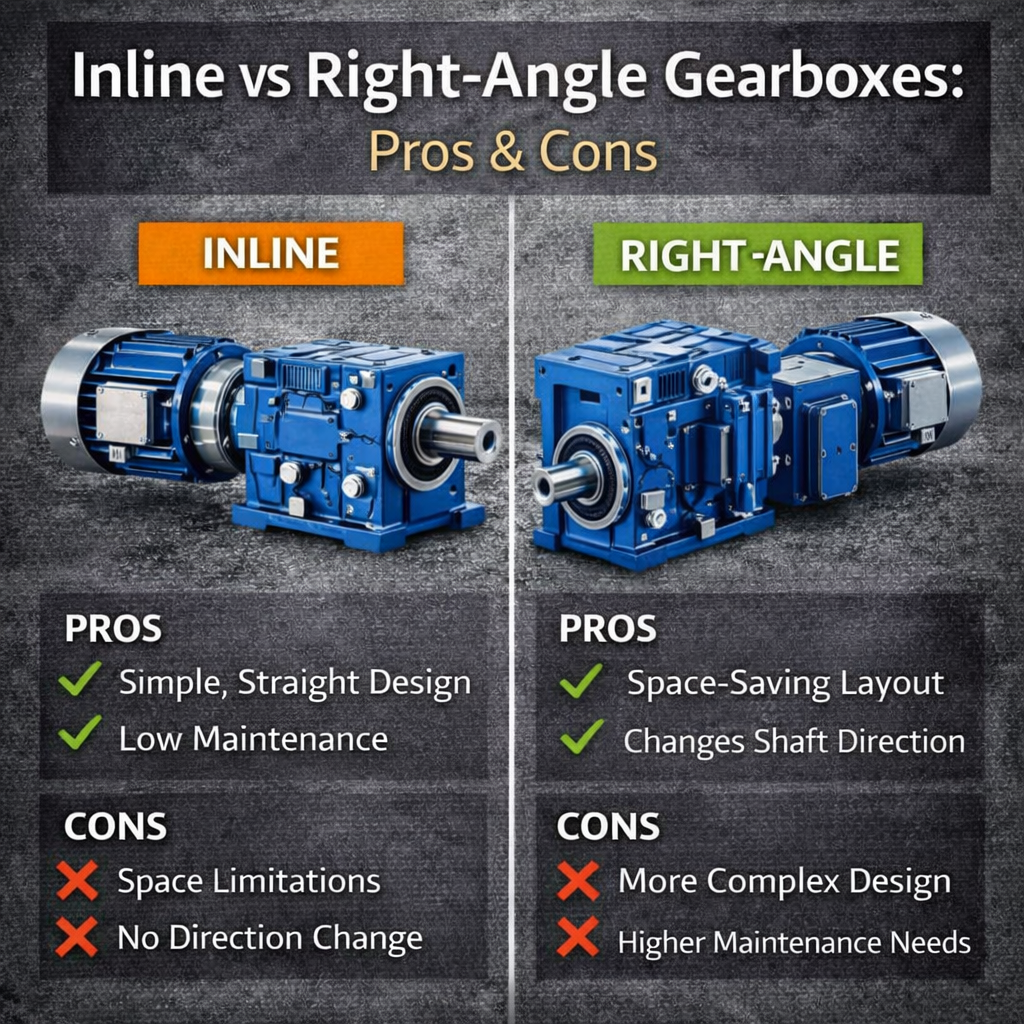
This article explains the pros and cons of inline and right-angle gearboxes so you can select the best option for your application.
What Is an Inline Gearbox?
An inline gearbox has its input and output shafts aligned on the same axis. Power flows straight through the gearbox without changing direction.
Inline gearboxes are commonly used in applications where space allows for a straight drivetrain and maximum efficiency is desired.
What Is a Right-Angle Gearbox?
A right-angle gearbox changes the direction of power by 90 degrees. Input and output shafts are perpendicular to each other.
Right-angle gearboxes are often used where space constraints, layout requirements, or equipment design require a change in shaft direction.
Efficiency Comparison
Efficiency is one of the biggest differences between inline and right-angle gearboxes.
Inline Gearbox Efficiency
Inline gearboxes typically offer higher efficiency because power flows in a straight line with fewer directional changes.
Advantages include:
Lower power losses
Less heat generation
Better overall energy efficiency
Longer lubricant life
Inline designs are often preferred in continuous-duty applications where efficiency matters.
Right-Angle Gearbox Efficiency
Efficiency varies by design.
Helical-bevel right-angle gearboxes offer good efficiency
Worm gear right-angle gearboxes have lower efficiency due to sliding contact
Lower efficiency leads to more heat and higher operating temperatures, especially in continuous-duty applications.
Space and Layout Considerations
Physical layout often determines gearbox choice.
Inline Gearbox Layout
Pros:
Simple, straight-line installation
Easy alignment
Compact length in some configurations
Cons:
Requires linear space
Not ideal for tight or compact equipment designs
Right-Angle Gearbox Layout
Pros:
Ideal for space-constrained layouts
Allows compact machine designs
Flexible mounting orientations
Cons:
Slightly more complex alignment
Additional considerations for lubrication and cooling
Right-angle gearboxes are often chosen when equipment footprint must be minimized.
Torque Capacity and Load Handling
Both designs can handle high torque when properly selected, but their strengths differ.
Inline Gearbox Torque Handling
Inline gearboxes:
Distribute load evenly along the shaft
Perform well under steady loads
Are well suited for high-speed, high-efficiency systems
They are commonly used in conveyors, fans, pumps, and general industrial machinery.
Right-Angle Gearbox Torque Handling
Right-angle gearboxes:
Handle torque well in compact spaces
Are commonly used in mixers, elevators, and material handling equipment
Must be carefully selected for overhung and axial loads
Helical-bevel designs handle torque better than worm gear designs.
Maintenance and Serviceability
Maintenance requirements differ slightly between designs.
Inline Gearbox Maintenance
Pros:
Simple internal design
Easier inspection and servicing
Lower operating temperatures
Typically longer oil change intervals
Inline gearboxes are generally easier to maintain over time.
Right-Angle Gearbox Maintenance
Cons:
Higher operating temperatures in some designs
More sensitivity to lubrication quality
Worm gearboxes may require more frequent maintenance
Proper lubrication and monitoring are critical for right-angle gearboxes.
Noise and Vibration
Noise levels vary by design and application.
Inline gearboxes typically:
Operate more quietly
Produce less vibration due to straight power flow
Right-angle gearboxes:
May produce more noise depending on gear type
Worm gear designs are often quieter at low speeds
Helical-bevel designs offer smooth operation at higher speeds
Noise requirements may influence selection in sensitive environments.
Mounting Flexibility
Right-angle gearboxes generally offer more mounting flexibility.
Inline gearboxes are typically mounted horizontally or vertically in line with the motor.
Right-angle gearboxes can be mounted in multiple orientations, making them ideal for complex equipment layouts.
Cost Considerations
Cost depends on gearbox type, size, and performance requirements.
Inline gearboxes:
Often lower cost for standard applications
Offer excellent value for continuous-duty systems
Right-angle gearboxes:
May cost more depending on design
Worm gearboxes are often less expensive upfront
Helical-bevel gearboxes may cost more but offer better efficiency and life
Total cost of ownership should be considered, not just purchase price.
Common Applications for Each Type
Inline gearboxes are commonly used in:
Conveyors
Fans and blowers
Pumps
Compressors
General industrial machinery
Right-angle gearboxes are commonly used in:
Mixers and agitators
Bucket elevators
Packaging equipment
Material handling systems
Space-constrained machinery
Which One Should You Choose?
Inline gearboxes are usually the best choice when:
Maximum efficiency is required
Space allows for straight-line installation
Continuous-duty operation is expected
Maintenance simplicity is important
Right-angle gearboxes are usually the best choice when:
Space is limited
Equipment layout requires a 90-degree turn
Compact design is critical
Mounting flexibility is needed
The right choice depends on application requirements, not just preference.
Final Thoughts
Inline and right-angle gearboxes both offer distinct advantages and disadvantages.
Inline gearboxes excel in efficiency, simplicity, and ease of maintenance, while right-angle gearboxes provide layout flexibility and compact design options.
Understanding these trade-offs ensures you select the gearbox that delivers the best performance, reliability, and long-term value for your application.
If you need help choosing between an inline or right-angle gearbox, IndustrialGearboxSupply.com can help evaluate your application and recommend the right solution.